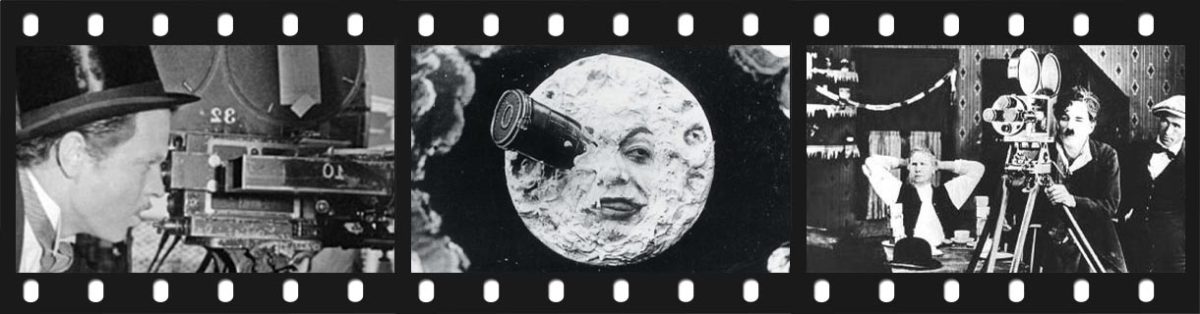
The Impossible Voyage (1904)

The Impossible Voyage (1904). 20 minutes. Directed by Georges Méliès. Starring Georges Méliès, Fernande Albany, and Jehanne d’Alcy.

Much like Georges Méliès’ 1902 silent short film A Trip to the Moon, the 1904 Méliès film The Impossible Voyage focuses on a group of proto-astronauts who plot to ascend to the heavens and explore the universe. As an adventure film and trick film, The Impossible Voyage clearly grows out of its sister attraction in terms of the earlier movie’s technological feats and focus on exploration. In the case of the 1904 film, however, the explorers land on the sun rather than the moon, do not encounter adversaries there, and end up journeying through the ocean in addition to the sky. Moreover, in comparison with A Trip to the MoonThe Impossible Voyage especially causes us to examine the character and ambitions of daring interstellar adventurers as they push forward, hell-bent on conquering the heavens; their at times reckless behavior … Read the rest
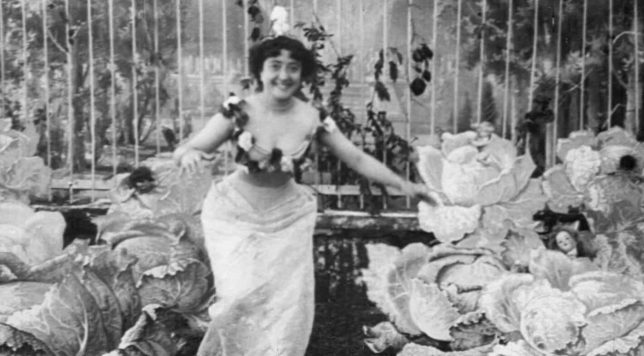
The Cabbage Fairy (1900)

The Cabbage Fairy (1900). 1 minute. Written and directed by Alice Guy-Blaché. Starring Yvonne Sérand (as the fairy).

The Cabbage Fairy is a short film by Alice Guy-Blaché, the world’s first female filmmaker. Originally based out of Paris and employed by the Gaumont Film Company (where she developed the Gaumont house style), Guy-Blaché worked as a director, producer, writer, and editor between 1896 and 1920, making approximately 1,000 (mostly silent) films during this period, of which 150 survive. Eventually she relocated to Fort Lee, New Jersey where she founded the Solax film studio in 1910, a time when films were exploding in popularity.

Many of her films are considered to be lost or else are not adequately documented, and Guy-Blaché herself has often been neglected as the pioneer that she was, with many of her films being misattributed to other, male filmmakers. Her work was a major influence on directors Alfred Hitchcock and Sergei Eisenstein (among others), and paved the … Read the rest

Battleship Potemkin (1925)

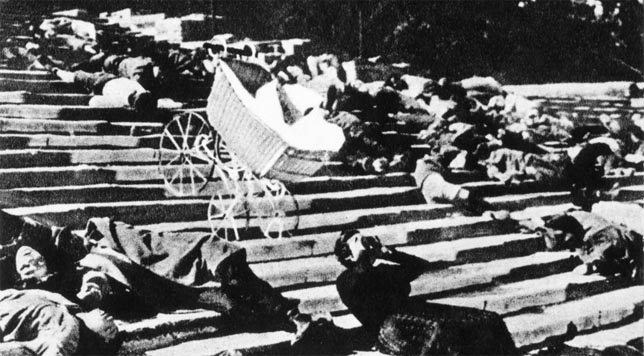
Battleship Potemkin (1925). 75 minutes. Directed by Sergei Eisenstein. Starring Alexsandr Antonov (as Grigory Vakulinchuk), Vladimir Barsky (as Commander Golikov), Grigori Alexsandrov (as Chief Officer Giliarovsky), Mikhail Gomorov (as militant sailor), Alexsandr Levshin (as petty officer), N. Poltavseva (as woman with pince-nez), Beatrice Vitoldi (as woman with baby carriage), Konstantin Feldman (as student agitator), and Lyrkean Makeon (as masked man).

Battleship Potemkin is a landmark Soviet propaganda film directed by Sergei Eisenstein. Filmmakers such as Billy Wilder and Orson Welles numbered it among their top favorites for its artistry, and it consistently places on Sight and Sound’s polls of the greatest movies ever made. Yet it may be difficult for some to accept Battleship Potemkin as one of the great films, or at least as an unhindered work of art, given the brutal realities of the regime that it was designed to serve as a mouthpiece for. Battleship Potemkin’s mission is, after all, to express Soviet political rhetoric as a … Read the rest

Piccadilly (1929)

Piccadilly (1929). 109 minutes. Directed by E. A. Dupont. Starring Gilda Gray (as Mabel Greenfield), Anna May Wong (as Shosho), Jameson Thomas (as Valentine Wilmot), King Hou Chang (as Jim), Hannah Jones (as Bessie), Cyril Ritchard (as Victor Smiles), and Charles Laughton (as nightclub diner).

Piccadilly is an impressive silent film. From its dazzling camera work, to its invigorating jazz-era atmosphere, to its use of stunning lead actress Anna May Wong, the movie infuses its scenes with beauty and a keen artistic sensibility. Piccadilly provides Wong—a Chinese American actress who left the United States for more meaningful parts in Europe—with a role of substance, and her work as the nightclub dancer Shosho overshadows the performances of her colleagues, including dancer Gilda Gray, who was at one point a well-known Ziegfeld girl. In the end, the movie, while perhaps less clichéd than Wong’s American projects, still relies on stereotypes to get its points across and concludes Shosho’s narrative in what feels … Read the rest

The Sheik (1921)

The Sheik (1921). 80 minutes. Directed by George Melford. Starring Rudolph Valentino (as Sheik Ahmed Ben Hassan), Agnes Ayres (as Lady Diana Mayo), Ruth Miller (as Zilah), George Waggner (as Yousaef), Frank Butler (as Sir Aubrey Mayo), Lucien Littlefield (as Gaston), Adolphe Menjou (as Raoul de Saint Hubert), and Walter Long (as Omair).

The Sheik has to be one of the strangest expressions of romance and sexuality that I have seen in a long time. It tells the story of an Arab sheik who abducts an English gentlewoman exploring the deserts of North Africa and holds her captive. At times we see that he hopes she will develop feelings for him, but at others he is intent on having his way with her whether she desires it or not. Regardless of his unsavory intentions, she does fall in love with him, but the movie’s celebration of both him and their relationship is difficult to admire. Overall, The Sheik is an … Read the rest

Steamboat Bill, Jr. (1928)

Steamboat Bill, Jr. (1928). 69 minutes. Directed by Charles Reisner. Starring Buster Keaton (as William Canfield, Jr.), Ernest Torrence (as William “Steamboat Bill” Canfield, Sr.), Marion Byron (as Kitty King), Tom McGuire (as J. J. King), and Tom Lewis (as Tom Carter).

Buster Keaton’s late silent film Steamboat Bill, Jr. was inspired by the 1911 song “Steamboat Bill” and in turn inspired Disney’s well-known 1928 animated short “Steamboat Willie” (the first cartoon to feature fully synchronized sound). In other words, it grew out of a timely reference and inspired a cartoon that may now strike us as antique. But watching Steamboat Bill, Jr. recently, I was struck by how timeless it is. The movie is not considered to be Keaton’s masterpiece—that honor falls to The General (1926)—but it still features outstanding riverbank stunts and an impressive hurricane sequence, complete with the famous shot of a building facade falling over Keaton’s head. However, part of what makes this movie and so … Read the rest

Modern Times (1936)

Modern Times (1936). 87 minutes. Starring Charlie Chaplin (as the Little Tramp), Paulette Goddard (as Ellen Peterson), Henry Bergman (as café proprietor), Stanley “Tiny” Sandford (as Big Bill), Chester Conklin (as mechanic), and Al Ernest Garcia (as president of Electro Steel Corp.). Written, directed, and scored by Charlie Chaplin.

Modern Times is very special: unusually clever, unusually bittersweet for a comedy, and unusually and deliberately archaic. I say “archaic” because although it is from the sound era, Modern Times is largely silent, just like its predecessor City Lights (1931), also directed by and starring Charlie Chaplin and also made during the age of sound. Chaplin’s rejection of the talkies was multifaceted, and in resisting sound, he primarily sought to preserve his silent-era persona—the character known as the Little Tramp, who he did not believe could survive in a  sound film. Modern Times, however, resists more than merely the demise of the Little Tramp at the hand of the new … Read the rest

The Lodger (1927)

The Lodger (1927). 91 minutes. Directed by Alfred Hitchcock. Starring Ivor Novello (as Jonathan Drew/the lodger), Marie Ault (as the landlady), Arthur Chesney (as her husband), June Tripp (as Daisy Bunting), and Malcolm Keen (as Joe Chandler).

Alfred Hitchcock’s silent thriller The Lodger is one of the earliest movies to express some of the director’s deepest preoccupations: the pursuit of an innocent man who is confused with a killer, the intersection of sex and murder, the experience of people who suspect someone in their circle of being a criminal, and the suffocating nature of crowds. As such, The Lodger is a rich repository of trademark Hitchcock elements, including his first cameo, and the director himself called it the first true Hitchcock film. At the same time, and paradoxically, the movie bears the marks of some of the other great European filmmakers of its time, such as F. W. Murnau and Fritz Lang. The Lodger is best understood as a transitional … Read the rest

The Kingdom of the Fairies (1903)

The Kingdom of the Fairies (1903). 17 minutes. Directed by Georges Méliès. Starring Georges Méliès and Bleuette Bernon.

Together with A Trip to the Moon (1902) and The Impossible Voyage (1904), The Kingdom of the Fairies is one of Georges Méliès’s most impressive silent short films. The story is of the variety that Méliès loved, involving an epic journey, fierce magical creatures, and a grand final spectacle with a parade. The plot, which is fairly simple, is enhanced by the beautiful and inventive visuals that Méliès incorporates throughout the film, and the movie as a whole functions as a kind of catalogue of the various special effects that Méliès was fond of using. Its elaborate sets and complex techniques are fascinating, and overall the film is one of Méliès’s best.

The movie begins in a royal palace with a prince and princess, whose betrothal ceremony we witness. An evil male witch materializes in the middle of the court, menaces the … Read the rest

The Gold Rush (1925)

The Gold Rush (1925). 95 minutes. Directed by Charlie Chaplin. Starring Charlie Chaplin (as the Little Tramp/Lone Prospector), Georgia Hale (as Georgia), Mack Swain (as Big Jim McKay), Tom Murray (as Black Larsen), Malcolm Waite (as Jack Cameron), and Henry Bergman (as Hank Curtis).

The Gold Rush is the silent film Charlie Chaplin hoped he would be remembered for. Set in the Yukon during the late nineteenth century, the movie features well-known Chaplin comedy routines such as the protagonist boiling and eating his own shoe, a tabletop dance with two bread rolls on the ends of forks, and a cabin that slides back and forth over the edge of a mountain cliff. But one of the movie’s most impressive accomplishments is the way that it develops Chaplin’s Little Tramp into a deeply moving, remarkably touching character, something that The Gold Rush was criticized for during its own time but that today makes it seem soulful.

The plot revolves around three … Read the rest