The Adventures of Prince Achmed (1926)

The Adventures of Prince Achmed (1926).  65 minutes. Written and directed by Lotte Reiniger. Cinematography by Carl Koch. Based on The Arabian Nights.

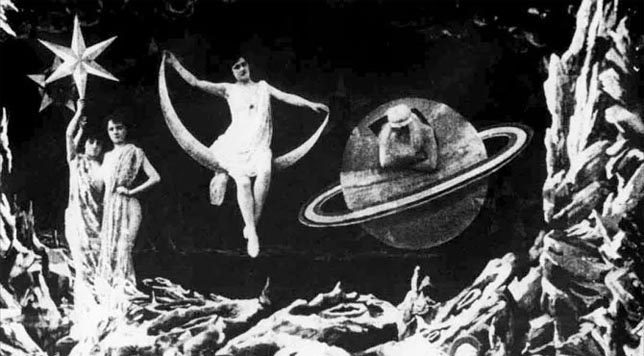
Lotte Reiniger’s The Adventures of Prince Achmed is the earliest surviving feature-length animated film. Based on The Arabian Nights and brought to life with silhouettes, its story is both refined and complex. Prince Achmed’s noble characters travel around the world, undertake fantastic quests, and perform heroic deeds in plotlines that interconnect and move fluidly across geography and time. Its art direction is also sublime. Although Reiniger’s use of silhouettes was not to become the norm in mainstream European and American animated films, her exquisite work hints at the possibilities inherent in animation before cel art became prominent. The movie is a shining example of the beauty, sophistication, and inventiveness typical of the late silent period.

When the story begins, a nameless African magician visits the court of the Caliph and presents him with a magic horse … Read the rest
Un Chien Andalou (1929)

Un Chien Andalou (1929). 21 minutes. Directed by Luis Buñuel. Starring Simone Mareuil (as young girl), Pierre Batcheft (as young man and second young man), Luis Buñuel (as man in prologue), Salvador Dalí (as seminarian and man on beach), Robert Hommet (as third young man), Fano Messan (as androgynous young woman), and Jaime Miraveilles (as seminarian). Written by Luis Buñuel and Salvador Dalí.

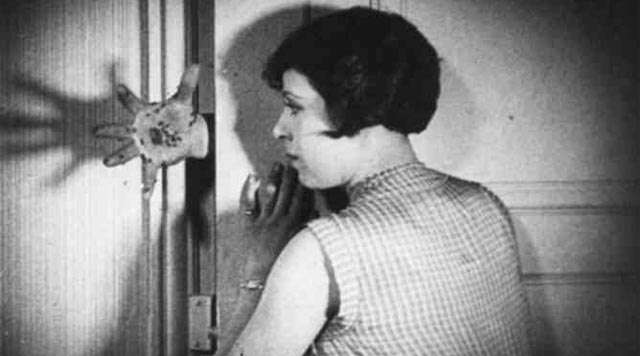
Un Chien Andalou is a silent short written by Luis Buñuel and Salvador Dalí that has developed a reputation among cineastes as required viewing. This surealist experiment, called “the most famous short film ever made” by Roger Ebert, was intended to shock audiences; Buñuel famously later said that he kept stones in his pocket at the premiere in case he needed to defend himself against enraged viewers. I would hesitate to say that it horrified the public, but it was a sensation and unnerved many of those who saw it. When viewing it recently, I had … Read the rest

The Last Laugh (1924)

The Last Laugh (1924). 91 minutes. Directed by F. W. Murnau. Starring Emil Jannings (as hotel doorman), Maly Delschaft (as his niece), Max Hiller (as her bridegroom), Emilie Kurz (as bridegroom’s aunt), Hans Unterkircher (as hotel manager), Olaf Storm (as young guest), Hermann Vallentin (as guest with pot belly), Georg John (as night watchman), and Emmy Wyda (as thin neighbor). Cinematography by Karl Freund.

The plot of The Last Laugh can be encapsulated in a simple sentence: an anonymous hotel doorman is demoted. Despite its simple premise, however, this silent movie is an astonishingly profound depiction of human misery. Relying on camera movement and gesture to convey meaning throughout, and using only one title card during its 91-minute running time, The Last Laugh relies more than most films on visual elements to tell its story. It is essential viewing for anyone who cares about early movies.

An enthusiastic hotel doorman is observed drinking on the job one day by the … Read the rest

The Great Train Robbery (1903)

The Great Train Robbery (1903). 12 minutes. Directed by Edwin S. Porter. Starring Alfred C. Abadie (as sheriff), Broncho Billy Anderson (as bandit, shot passenger, and dancer), Justus D. Barnes (as bandit who fires at camera), Walter Cameron (as sheriff), Donald Gallaher (as little boy), Frank Hanaway (as bandit), Adam Charles Hayman (as bandit), John Manus Dougherty, Sr. (as bandit), Marie Murray (as dancer), and Mary Snow (as little girl). Written and produced by Edwin S. Porter.

The silent short The Great Train Robbery is considered to be a landmark in early film. It is the first Western (although it was not shot in the American West), the first action film, and one of the first narrative films. It features legendary Western actor Broncho Billy Anderson, who would go on to found Essanay Studios near Fremont, California. It also contains one of the most iconic final images in all of film: in the last frames, a bandit (played by … Read the rest

A Trip to the Moon (1902)

A Trip to the Moon (1902). 16 minutes. Directed by Georges Méliès. Starring Georges Méliès (as Professor Barbenfouillis); Bleuette Bernon (as Phoebe); François Lallement (as officer of the marines); Henri Delanney (as captain of the rocket); Jule-Eugène Legris (as parade leader); Victor André, Delpierre, Farjaux, Kelm, and Brunnet (as astronomers); Ballet of the Théâtre du Châtelet (as stars and cannon attendants); and the acrobats of the Folies Bergère (as Selenites). Written and produced by Georges Méliès.

A Trip to the Moon is without a doubt one of the most iconic movies ever made. Fritz Kramer has argued that the film’s moon, which is styled as a human face, is so famous that it “is instantly recognizable even to people who have never seen a single silent film.” The movie is based on the Jules Verne novels From the Earth to the Moon (1865) and Around the Moon (1870), as well as H. G. Wells’s The First Men in the Moon Read the rest

The Jazz Singer (1927)

The Jazz Singer (1927). 96 minutes. Directed by Alan Crosland. Starring Al Jolson (as Jakie Rabinowitz/Jack Robin), Warner Oland (as Cantor Rabinowitz), Eugenie Besserer (as Sara Rabinowitz), May McAvoy (as Mary Dale), Otto Lederer (as Moisha Yudelson), Richard Tucker (as Harry Lee), Bobby Gordon (as Jakie Rabinowitz at age 13), and Yossele Rosenblatt (as himself).

It occurred to me recently as I was watching The Jazz Singer that I had seen two of its musical sequences before: the famous “My Mammy” number that Al Jolson sings in blackface, of course, but also the “Toot, Toot, Tootsie (Goo’ Bye)” performance. The latter is shown playing on a television in the movie Goodfellas (1990) when federal agents arrive to search the home of Karen Hill (played by Lorraine Bracco). Karen’s husband Henry is a gangster, and the family home is frequently raided, but Karen has become inured to the presence of the agents. When they show up on this particular occasion, she … Read the rest

Nosferatu (1922)

Nosferatu (1922). 94 minutes. Directed by F. W. Murnau. Starring Max Schreck (as Count Orlok), Gustav von Wangenheim (as Thomas Hutter), Greta Schröder (as Ellen Hutter), Alexander Granach (as Knock), John Gottowt (as Professor Bulwer), and Georg H. Schnell (as Harding). Based on the novel Dracula by Bram Stoker.

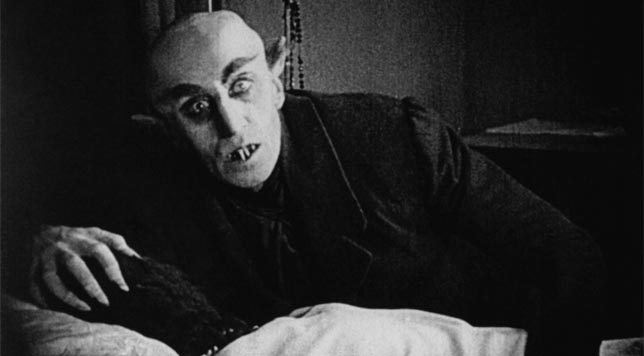
We are fortunate to have F. W. Murnau’s Nosferatu in any form at all. The movie is based on Bram Stoker’s novel Dracula (1897), but Murnau never obtained permission from the Stoker estate to film his adaptation. Although the names and places were changed in the film from the original novel (this was done as a precaution), Nosferatu was still essentially Dracula. When Stoker’s widow determined that Murnau had made a film of her husband’s novel without her approval, she sued for breach of copyright in Germany and won. A judge ordered all existing copies of the film destroyed. Fortunately, Nosferatu had already been imported to France, and it is … Read the rest

It (1927)

It (1927). 72 minutes. Directed by Clarence G. Badger. Starring Clara Bow (as Betty Lou Spence), Antonio Moreno (as Cyrus Waltham, Jr.), William Austin (as Monty), Jacqueline Gadsden (as Adela Van Norman), Priscilla Bonner (as Molly), Gary Cooper (as reporter), and Elinor Glyn (as herself).

According to Elinor Glyn, whose serialized novella “It” was the inspiration for the movie of the same name, “It” is:

“…that quality possessed by some which draws all others with its magnetic force. With ‘It’ you win all men if you are a woman and all women if you are a man. ‘It’ can be a quality of the mind as well as a physical attraction.”

This sounds very similar to the definition of the so-called “X-factor,” the mysterious source of talent that entertainment industry casting directors, talent managers, and moguls claim emanates from great film and theater stars. It seems a bit strange to suggest that what governs our sexual and romantic interests also … Read the rest

The Passion of Joan of Arc (1928)

The Passion of Joan of Arc (1928).  114 minutes.  Directed by Carl Theodor Dreyer.  Starring Renée Jeanne Falconetti (as Joan of Arc), Eugène Silvain (as Évêque Pierre Cauchon), André Berley (as Jean d’Estivet), and Antonin Artaud (as Jean Massieu).  Cinematography by Rudolph Maté.

In honor of the San Francisco Silent Film Festival, I am writing about a silent film that has disturbed me more than any other film, silent or otherwise, that I have seen in a long time.  It is Carl Theodor Dreyer’s The Passion of Joan of Arc.  In response to the film’s intense emotional focus, Roger Ebert wrote, “Perhaps the secret of Dreyer’s success is that he asked himself, ‘What is this story really about?’  And after he answered that question, he made a movie about absolutely nothing else.”  Ebert does not explicitly tell us what that answer is, but I have an idea.  Dreyer has made a movie that is about a horrifying … Read the rest

Greed (1925)

Greed (1925).  Directed by Erich von Stroheim.  140 minutes (MGM) / 239 minutes (restored version, 1999).  Starring Gibson Gowland (as John McTeague), Zasu Pitts (as Trina Sieppe), and Jean Hersholt (as Marcus Schouler).

Greed is based on the 1899 American novel McTeague by Frank Norris.  It takes place at the turn of the nineteenth century in California and was one of the first Hollywood films to be shot entirely on location.  As the story opens, McTeague, a miner, leaves his California mountain town to train as a dentist.  When he opens a practice in San Francisco, he meets Marcus Schouler and Schouler’s cousin Trina, with whom McTeague falls in love.  Trina wins $5000 in a lottery and marries McTeague, but soon she begins to obsess over her winnings and becomes miserly towards her husband.  Because Schouler feels cheated both out of Trina, whom he loved, and her fortune, he reports on McTeague to the dental board, which determines that he … Read the rest