
Christmas in July (1940). 68 minutes. Directed by Preston Sturges. Starring Dick Powell (as Jimmy MacDonald), Ellen Drew (as Betty Casey), Raymond Walburn (as Dr. Maxford), Alexander Carr (as Mr. Shindel), William Demarest (as Mr. Bildocker), Ernest Truex (as J. B. Baxter), Franklin Pangborn (as Don Hartman), and Georgia Caine (as Ellen MacDonald). Written by Preston Sturges.
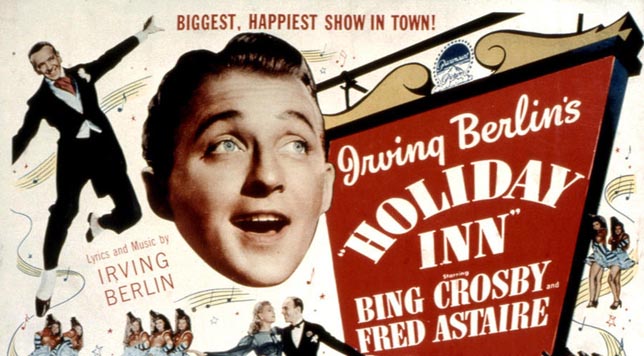
Christmas in July might initially appear to be a holiday film akin to It’s a Wonderful Life (1946), Christmas in Connecticut (1945), or Holiday Inn (1942); but Christmas in July, in spite of its name, is not an actual Christmas movie and does not take place during the holiday season. (It is also not the origin of the phrase, “Christmas in July,” which has roots in the late 19th century.) The movie is instead about gift-giving and abundance manifested outside of the winter months—in the spirit of Christmas beneficence but devoid of the religious sentiment. The film’s protagonist, Jimmy MacDonald, is an aspiring advertising executive who one summer wins, or thinks he wins, a massive prize in an ad campaign contest and spends his winnings liberally on those he loves, creating a kind of Christmas for his neighborhood in the off season. The movie is about Jimmy’s spending behavior and largesse but also about the philosophical framework that underpins ideals of wealth, spending, and consumption: namely, capitalism and its accompanying excesses.
Yet Christmas in July does not condemn its characters for their dreams of money. Instead, the movie aligns itself with many other pre-war stories that normalized financial aspirations and posited that grand wealth was just around the corner—hiding behind a dowager aunt twice removed or a random contest. But it also does so while sharing the utter heartbreak of its characters as they rise from one station to another and then fall back down again. The protagonists’ sweet fantasies are rooted in a financial hopefulness that is as ill-advised as it is obsessive; and yet in this movie, who in their homes, businesses, or neighborhoods is not also consumed by it? Through its depictions of widespread financial desire, sudden wealth, and rampant spending, Christmas in July offers a radical critique of a society motivated by money and the crushing disappointments that accompany our slavish devotion to possessions and prosperity.
In Christmas in July, clerk Jimmy MacDonald, who works for E. Baxter and Sons Coffee, dreams of winning a slogan contest for a rival company, Maxford House Coffee. The $25,000 prize will seemingly solve all of his problems, enabling him to propose to his girlfriend Betty and rescue his mother from her working-class existence. Three of his colleagues at work decide to play a prank on him and create a telegram that informs him he has won the contest. As a result of this news, Mr. Baxter offers Jimmy a promotion and his own office. Ecstatic, Jimmy rushes over to Maxford to claim his prize. Dr. Maxford is confused; he believes that the contest jury, led by Mr. Bildocker, is deadlocked on the issue of who the winner should be, but he cuts Jimmy a check nonetheless.
Jimmy goes on a spending spree, buying nearly everything in a department store and giving liberally to his whole neighborhood. He pays for a massive street fair for all of the residents. Meanwhile, Maxford learns that the check is a mistake and that Jimmy is not really the winner, and speeds over to Jimmy’s neighborhood to reclaim his money. He is followed by the department store owner, Mr. Shindel, who has also learned that Jimmy is a fraud. Jimmy is distraught. He makes his way back to Baxter’s office to tell him he is not really a winner, but Betty persuades Baxter to take a chance on Jimmy nonetheless. As Betty and Jimmy wander back to Baxter’s elevator to face their renewed poverty, the movie cuts to Bildocker bursting into Maxford’s office to finally announce the winning slogan: it is Jimmy’s after all. Oblivious to this development, Jimmy and Betty get into the elevator in Baxter’s building and begin to descend back to reality, but we know that when Jimmy arrives on the ground, he will receive the news that he is truly a winner.
Pre-war film protagonists, such as Jimmy in Christmas in July and Longfellow Deeds in Mr. Deeds Goes to Town (1936), are frequently the beneficiaries of wild plots that involve money falling out of the sky—a theme that suggests one way to solve the financial problems of the time was through the unpredictable forces of fate, luck, and divine favor. In Christmas in July, Jimmy MacDonald enters a slogan creation contest that will drop a lottery-sized prize in his lap, but in order to receive the prize, he must beat thousands of competitors. We see the boardroom in which the contest jury deliberates, and it is piled high with submissions. The odds seem impossible—only Jimmy’s cleverness will save him.
Jimmy’s mother may believe in him (“There’s money in your cup,” she reverently observes to him over breakfast), but his chances of winning the contest seem slim because nobody with whom he shares his slogan appears to understand it, and that includes the head of Maxford Coffee himself. As an enthusiastic sloganeer, Jimmy creates taglines for products that pass muster due as much to his passion and conviction as to their spunky, befuddling nature, and there is not one slogan that Jimmy presents that does not require explanation. His winning slogan for Maxford, “If you don’t sleep at night, it isn’t the coffee—it’s the bunk,” may mean that sleepless coffee drinkers should blame their beds rather than their beverage (i.e., rather than Maxford coffee). But does it additionally imply that other coffee has garbage ingredients whereas Maxford’s does not? Or could it possibly be Maxford coffee that is full of bunk? Because the slogan does not specify the brand it is advertising, it is generic in nature, and while a general quality can make an ad sound as if it contains a truth that has emerged from nature, here instead the ambiguity merely contributes to a confusing message.
Jimmy’s second slogan (for Baxter) is also fraught with problems—“Baxter’s best, the blue-blood coffee: it’s bred in the bean.” The potential for confusion here is just as great: “bred in the bean” could just as easily be “bread in the bean” to the listener. Moreover, it is not clear what the “it’s” refers to—what exactly, we might wonder, imbues the beans with their excellent pedigree? Any slogan that makes us wonder about these kinds of details gets away from its chief mission: to sell the product without inspiring thought in the consumer. Jimmy may obsess over the language that drives profit, but his understanding of what that language should sound like is as mindless as the bosses that helm the companies he seeks to enrich.
Jimmy initially brews up taglines in his spare time for hit-it-big contests; but soon he transitions from an after-hours sloganeer, who dreams of great rewards on his tenement rooftop, to an official member of the business world, complete with a private office. And yet entering into the world of corporate work does not entirely, for Christmas in July, mean abandoning the dreamy sparkle of Jimmy’s evening star-gazing sessions. Instead, the film implies from beginning to end that the advertising world that Jimmy MacDonald longs to be a part of is, at least superficially, a stimulating, creative world full of energy and ideas. (For the men in the office, work seems to be more a thing of play than of labor: “Now that you’re a capitalist, I don’t know how you feel about working for a living,” Baxter says to Jimmy after he learns of Jimmy’s win, implying that what the men do in the office is not necessary for their financial well-being.)
The scene of Jimmy describing his ideas to Mr. Baxter and his cohort behind closed doors might at first suggest that business is a fertile industry full of men who listen to big schemes and entertain wild, romantic ideas of how to run their operations. The scene has a bit of the aura of a coffee house during poetry night, albeit with formal suits, with mass-market transactions rather than cups on bistro tables, and with Jimmy reciting his advertising concoctions as if they were some kind of powerful free verse. As the men chomp on cigars, oblivious to the silliness of Jimmy’s flashy language, the bosses’ world seems both fanciful and reckless—far from stuffy and regimented. Outside in the large room full of desks where the workers crunch their numbers, the men clack-clack-clack on adding machines in neat rows, wear white work coats, and stand and sit in unison. Perhaps for those men (of whom Jimmy is initially one), work is antiseptic, formal—even stodgy. But for the men in Baxter’s office, there is much to create.
Yet a creative life in the corporate seat, Christmas in July suggests, is as much a load of bunk as the rival coffee that Jimmy’s slogan confusingly characterizes. The backroom business opportunities that Jimmy rises up to greet may suggest an almost beautiful alternative to the world of the regimented desks and smocks of the firm’s main room. But its creativity is largely a farce, consisting of words that are merely an empty jumble of corporatese, full of hot air. Life in Baxter’s leather-upholstered offices is just as cold as the big drafty room full of adding machines; and as is evinced by the fallout from Jimmy’s fake contest win, that world can be revoked in an instant.
Business, however, comes in all different sizes and forms in Christmas in July. Consider the sheer variety of salesmen that we see. The peddlers draw from their integration into the neighborhood landscape and make use of their personal relationships with residents to sell on a small scale. The floor attendants cater to the specific requests of the shoppers. And the department store owner Mr. Shindel emerges from his office to lavish attention on high-profile guests and make them feel singled out, even privileged.
When Jimmy wins the contest, he and Betty know just where to go: they head right over to Shindel’s to embark on a wacky shopping spree. The retail businessman has a product to meet Jimmy’s every need—Jimmy and Betty mention that Betty’s mother could use a new iron, and the store has exactly what they desire. As the two big spenders finally climb into a cab to head back to their neighborhood, Shindel’s men pack their wrapped purchases around them, then start to push packages through the window, so that what the couple has bought spills into the car in a plentiful waterfall of brown paper and string. Their cab departs, and Shindel directs three additional cabs stuffed to the brim to follow behind them. Before they leave, Shindel pins corsages on Jimmy and Betty to commemorate their day (and their spending), suggesting that their time in his store has not only been rewarding financially for the business owner but personally meaningful for the two shoppers as well. The fact that Shindel and his colleagues are so helpful and courteous makes the business of buying seem like a business of friends. What Shindel is selling is therefore made up as much of sentiment as it is of products—a feeling that purchasing something takes on a significance that is greater than the transaction itself.
Shindel could be a Jewish stereotype—the palm-rubbing, scheming businessman whose compassion is checked by money. But there are also Jewish alternatives to him in this film: for example, the vegetable vendor on Jimmy’s street, who encourages the children to pelt Maxford with overripe produce from his cart. Shindel is also counterbalanced by Mrs. MacDonald’s friends in the tenement, who clearly know Jimmy well and support her when she thinks that he might be hurt based on a frantic phone call from him (not understanding that he thinks he has won the contest). Shindel does not seem any more greedy than Maxford or Baxter, and what is more, he actually reforms more quickly than either of them to support Jimmy. That is to say, while Shindel may be a stereotype, his greed is matched by the avarice of non-Jewish businessmen who operate on an even larger scale than he does, and thus he seems to be more of a part of a continuum of greed and capitalism in the film than a standalone component to Jimmy’s problems.
Conspicuous consumption and the pleasure that we take in making purchases are most potently on display in the Davenola that Jimmy purchases at Shindel’s, which would elsewhere be called a sofa bed. Here, however, the familiar product of the sofa bed is transformed from a simple piece of convertible furniture with its one gimmick into a couch that becomes a virtual entertainment center with buttons that produce a radio and beverage set as the bed appears. It is hideous, yet it embodies the glorification of mechanization, all-in-ones, and domestic luxury. The Davenola is Jimmy’s mother’s dream, and Jimmy exercises the full fantasy of capitalist bliss when he acquires it on her behalf.
The Davenola resembles a World’s Fair couch of the future, a piece of machinery that thrills its owner with the luxury of an additional bed equipped with bells and whistles. It nevertheless underscores that the déclassé customer who is interested in it is looking for something that will essentially save space in a small apartment that is not large enough for a guest room. So the proposed luxury of the Davenola is essentially a lie—if it were truly luxurious, it would likely simply be a guest bed that doubles as nothing. In the end, when Jimmy’s coworkers appear with a supposedly equivalent couch that converts into a bed with a handle crank that breaks off in the street, the comparison between perceived true luxury and the everyday becomes evident.
So much of what we see in the film is an illusion like the Davenola: the relationship with Shindel, the check and the telegram that Jimmy receives, Jimmy’s promotion and new office, the terms of his engagement to Betty. All of the buying, spending, and advertising is just a lot of fakery. What, we might then ask, do we see that is real? Presumably Jimmy and Betty’s love for each other is real, although her feelings for him certainly become warmer and more enthusiastic once he has received the telegram acknowledging him as a winner and once she has been draped in diamonds and furs. And Jimmy’s desire to be a success is also real, although that desire is built on the lies of advertising.
But Jimmy and Betty do not want what is real: they want the fantasy, the promise of an alternate present and an imaginary horizon. At the movie’s conclusion as they trace their steps out of Baxter’s office, they descend in an elevator back to their quotidian lives, trudging towards a present and future that they do not want, accompanied by a wispy, heartbreaking score full of longing. A meowing black cat, standing in the lobby, gets the final say as a symbol of their bad luck and indeterminate future. But even at the bottom of an elevator shaft, it will be hard for them to let go of their dreams—including the lucrative ones, filled with drama and promises. It is easy to be swept away by a cigar-drenched office by day; it is harder to say goodbye to heady promises in the same office after hours.
Christmas in July channels the spirit of its titular holiday in the sense that the plot involves all of the giving that we associate with the Christmas season. But it also channels the complex, multifaceted nature of modern-day American Christmas. The movie’s Christmas is Christmas at the end of the day, when all of the presents are opened and all of our loved ones have gone—the anticlimactic ending to a pumped-up twenty-four hours that are supposed to be full of joy.
As consumerism and grief eclipse the holiday spirit of Jimmy’s giving, we might wonder how the holiday’s manifestations in this film, or in real life, truly channel the spirit of selfless love; for to be rescued from the lonely evening of the great festivities, only the promise that Jimmy’s wealth will be reignited and his material resources reinstated can save this movie’s Christmas. But it is not clear who or what will rescue Jimmy from the solitary hours of his next Christmas evening, when the presents dry up and his big check is cashed. Once Jimmy’s portfolio is reinstated, we don’t know for how long the street carnival will continue, or for how long the thrill of spending will keep Jimmy’s version of Christmas a fulfilling experience.
Men like Baxter and Maxford are set regardless of the sea change of public whims and coffee preferences. For men like Jimmy, however, the wheel of fortune never stops turning. We may understand that Jimmy will soon be rich again, but the prospect of him spending to the bottom of his wallet again is real, too, and the film leaves us with lingering uncertainty about his long-term fate. Life in between holidays in Christmas in July is as thin and easily crumpled as the paper that money is printed on, or is as fragile and flimsy as a check that can be torn up and thrown down on the street. The pleasure of Christmas in this movie may be a respite from the discontent of our brittle realities, but it is only a respite, for the yearning of the heart at all other times is as strong as the night is long, and Christmas, whether in December or in July, is after all only one day.