The Invisible Man (1933). 70 minutes. Directed by James Whale. Starring Gloria Stuart (as Flora Cranley), Claude Rains (as Dr. Jack Griffin), William Harrigan (as Dr. Arthur Kemp), Henry Travers (as Dr. Cranley), Una O’Connor (as Jenny Hall), Forrester Harvey (as Herbert Hall), Dudley Digges (as Chief of Detectives), Harry Stubbs (as Inspector Bird), E. E. Clive (as Police Constable Jaffers), Dwight Frye (as reporter), and Merle Tottenham (as Millie). Cinematography by Arthur Edeson. Special effects by John P. Fulton. Based on the novel by H. G. Wells.
H. G. Wells was in general not a fan of adaptations of his novels, but in 1935 he gave an interview with Pearl Katzman in Screenland magazine that indicated there was a soft spot in his heart for the 1933 film version of his novel The Invisible Man. Compared to Island of Lost Souls (1932), an adaptation of The Island of Dr. Moreau that Wells utterly loathed, the film of The Invisible Man was preferable to him in many regards, albeit with some considerable caveats:
“It was more exactly as I conceived it. The casting, the acting, the mood, the supervision—very good.”
Wells was pleased with the excellent trick photography employed to present a picture of apparently empty clothes walking and moving. Claude Rains’ voice, dominating the production, carried a sinister note which helped the tone of the film considerably. The minor characters too, Wells thought, were nicely cast. Una O’Connor and Forrester Harvey offered good characterizations of innkeepers in a true English countryside.
“…[B]ut even that was not what it should have been… No film can be produced correctly unless the author of the book is present to supervise production. Until this is permitted, producers will never learn how to make a faithful reproduction of a novel… [The books] will never be handled properly… unless I am present on the set to supervise backgrounds and characterizations.
Wells is right that, among other things, the movie’s cast, particularly Claude Rains as the titular character and Una O’Connor as his comic foil, is exquisite, as is its direction by legendary horror filmmaker James Whale, who also made Frankenstein (1931) and Bride of Frankenstein (1935). But in the quotation above, Wells self-importantly denies adaptations both independence and the expression of the peculiar life force of their times. The 1933 Invisible Man certainly takes its inspiration from the nineteenth-century novel, but it quickly becomes evident that the film has an existence of its own, outside of its source material, and that is a good thing. Its special effects, cutting edge for its time and far beyond what anyone reading Wells’s novel in 1897 could have believed possible, are wonderful and hold up well nearly one hundred years later. And the movie’s use of the pre-Code era milieu—including campy depictions of gender, an astonishing subtext about the radical powers of nudity, and a subversive commentary about the value of revolution—rivals the 1930s Zeitgeist evident in movies from Scarface (1932) to Hallelujah! I’m a Bum (1933). Indeed, the movie’s invisible man (whose physical state is the result of a scientific experiment gone haywire) is a kind of criminal jester made possible by Depression-era discontent, a human id delighting in destruction who enacts some of that audience’s most potent fantasies about overturning the institutional norms that by 1933 had failed society so dramatically. Whales’s creation may cause us to laugh, may repulse us, or may effect something in between, but regardless of the audience’s reaction, The Invisible Man inescapably destabilizes what many of us take for granted—namely, the directness of sight and our ability to perceive boundaries—and frightens us in a way that only a visual medium can, not only with the criminality of its protagonist but with the horror of what cannot be seen.
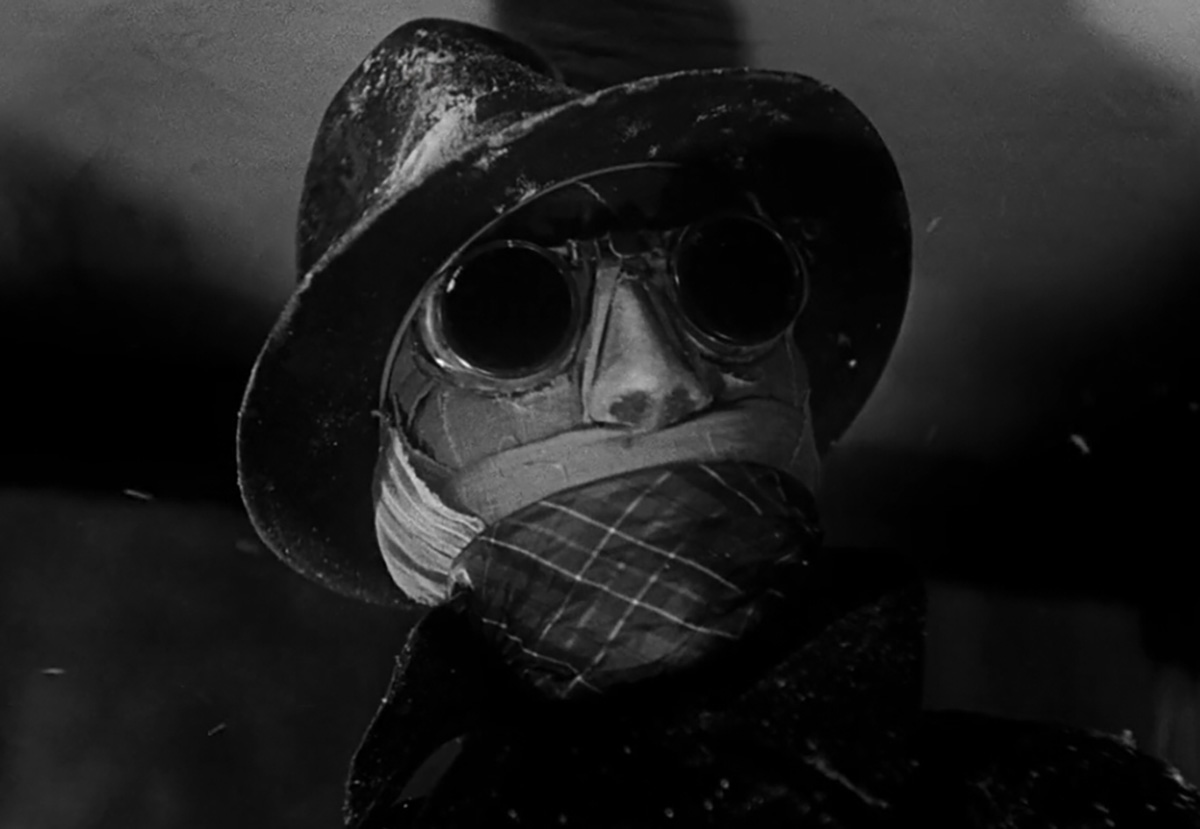
On a snowy evening in the English village of Iping, a mysterious, bandaged-wrapped, sunglasses-wearing stranger arrives at an inn and demands lodging. It turns out that the man is Dr. Jack Griffin, a chemist who as part of an experiment has secretly turned himself invisible but cannot concoct a serum to transform back into his non-invisible state. The innkeeper and his wife, perceiving Griffin’s strange behavior and hostility as he turns his rented room into a chemistry lab, demand that he leave, but he assaults them and strips his bandages and clothes away, revealing to the pub crowd below that he cannot be seen. Griffin escapes to his colleague Kemp’s house, demands food and clothing, and insists that Kemp assist him in his project of regaining visibility and channeling the drug’s power to gain political and financial Macht. The invisibility serum has made Griffin aggressive, megalomaniacal, and power-mad: he is convinced that his drug will make him the most powerful man in the world and enable him to create armies of invisible men to do his bidding. He threatens Kemp angrily and the man complies in fear. Kemp summons Griffin’s girlfriend Flora and her father, Dr. Cranley (another of Griffin’s colleagues) to the house to reason with Griffin, but the latter man is undeterred in his quest to take over the world and again escapes sans clothes and bandages into the wild—thwarting a police campaign to seize him, murdering innocent bystanders, and generally creating violent mayhem. In revenge he kills Kemp, who has been assisting the police, and flees to a barn, where he is tracked down and shot by the law. In the movie’s final scene, Griffin, dying in a hospital bed, is visited by the Cranleys, who hear his final peaceful remarks as he slips into death, growing visible again after he ceases to be.
Because The Invisible Man is a horror film, it is reasonable to expect it to be gilded with special effects, costuming, and makeup. Here John P. Fulton’s effects do not disappoint—in fact, they hold up rather well. As Fulton explained in the September 1934 issue of American Cinematographer, the scenes with partial invisibility were the trickiest to shoot. For the moments where Griffin disrobes, Fulton draped the sets in black velvet and dressed bits of actor Claude Rains to match. Rains wore something approximating a black diver’s helmet to obscure his head, with tubes to supply him with air (he fainted while wearing it at least once). In post-production, Fulton used a combination of negative and positive prints to enhance the illusion of Griffin’s unseeableness, and tens of thousands of film frames were adjusted by hand to remove the appearance of the actor’s white eyeballs. Full invisibility was easier to demonstrate: through the use of wires, Fulton managed to make it appear that the invisible Griffin smokes a cigarette; picks up things like bandages and gloves; gathers up books and lowers them out of an open window; and pushes a chair forward and rocks in it. Additionally, for the climactic scene in which Griffin’s footsteps appear in the snow and reveal him to police, Fulton installed a wood panel beneath the snowy floor of the set and pulled foot-shaped pieces through the board to create the impression of the character’s tread.
Although our experience of Griffin’s campaign is enhanced by the film’s special effects, his success within the narrative is limited by the power of them in a meta sort of way. In a sense, to him the movie’s technology is a drawback that enables his feet to be spied in the snow. He explains to Kemp:
There are one or two things you must understand, Kemp. I must always remain in hiding for an hour after meals. The food is visible inside me until it is digested. I can only work on fine, clear days. If I work in the rain, the water can be seen on my head and shoulders. In a fog, you can see me like a bubble. In smoky cities, the soot settles on me until you can see a dark outline. You must always be near at hand to wipe off my feet. Even dirt between my fingernails would give me away.
It is as if Griffin is weirdly aware of the power of film technology to hinder him and is trying to find a way to combat The Invisible Man’s visual tricks, to prevent them from being realized, even as he expresses himself through them. His struggle is evident both when he attempts to be unseen and when he strives to be seen. In the scenes where he dresses in bandages, he is so beautifully wrapped, as if he were a mummy, wearing dark goggles that make him appear to be from another world; but in bandaging himself, Griffin does not merely create a striking look that prevents the detection of his secret—he essentially attempts to thwart the power of special effects to reveal his true self. Until the scene in the snow, he controls his appearance. He is the one who can choose whether to trigger the optical illusions or not depending on his mood, by unwrapping or remaining clothed, by cleaning his fingernails, and by staying out of the rain. But film effects prevent him from getting what he wants just as people get in his way, too, and ultimately the power of both damn him to a death in the cold English snow that he cannot successfully prevent.
Although The Invisible Man’s special effects are complex and make the unbelievable seem so very real, the monster in this film is simply a living man who has done something awful to himself, rather than a mummy who has come back to life; or a revivified, pieced-together corpse; or a befanged supernatural specter. He is no creature from the black lagoon, and his drug does not cause him to develop gills, antennae, wings, or a hairy face. Prior to his transformation, he is a nerdy scientist and impoverished guy who is trying to make a name for himself so that he can establish a life with his girlfriend. It is only after the success of his experiments that he becomes monster-like, but even then he is more of a self-made criminal than a supernatural force. Although he comes to relish his ability to wreak havoc on the local community, he is also desperate as he struggles to find a way to reverse his condition. Being able to undo his invisible state will naturally make his potion more marketable (it is probably not the case that the world’s soldiers want to become invisible in battle and then remain that way forever in their personal lives). But it will also mean that he can resume his relationship with Flora, something that he expresses a longing for during their tender scene together at Kemp’s. Griffin’s dialogue there reveals him to be rather sensitive and sweet:
Flora: Why did you do this?
Griffin: For you, Flora.
Flora: For me?
Griffin: Yes, for you, my darling. I wanted to do something tremendous, to achieve what men of science have dreamt of since the world began, to gain wealth and fame and honor, to write my name above the greatest scientists of all time. I was so pitifully poor. I had nothing to offer you, Flora. I was just a poor, struggling chemist.
Indeed, part of the horror of Griffin’s story is that when Griffin becomes invisible, he does not really become something else. Rather, Griffin becomes more intensely human, embracing the worst aspects of the species in a spectacular way. His quest to develop his invisibility into the ultimate tool for ruling nations becomes a steroid-driven political passion rather than the dumb path of a humanoid beast—transforming him not just from visible to invisible but also from a state of humility to a state of hubris that is limited to humans and is a kind of specialty of the worst of us. He grabs at the world with a translucent fist like a power-hungry dictator, of which there was certainly no shortage in 1933. To Constable Jaffers and the guests at the inn he proclaims, “An invisible man can rule the world. Nobody will see him come, nobody will see him go. He can hear every secret. He can rob and kill!” In his first scene with Kemp, he speaks with a similar conviction: “The drugs I took seemed to light up my brain,” he proclaims to Kemp with a noted lack of remorse. “Suddenly I realized the power I held—the power to rule! to make the world grovel at my feet…” And later he remarks to Flora:
You think [your father] can help me? He’s got the brain of a tapeworm, a maggot, beside mine! Don’t you see what it means? Power! Power to rule! To make the world grovel at my feet!… Power, I said! Power to walk into the gold vaults of the nations, into the secrets of kings, into the Holy of Holies; power to make multitudes run squealing in terror at the touch of my little invisible finger. Even the moon’s frightened of me, frightened to death! The whole world’s frightened to death!
He cannot be other then, cannot be a monster in the sense that his fellow Universal creatures are—he is too much like us. When he hides amongst the crowds of policemen, as imperceptible as the air they breathe, Griffin nevertheless blends in amongst their phalanxes as one of their own, an extension of them rather than someone outside of them. Though he thwarts their efforts to catch him and eventually graduates to far worse crimes, the imperious hold of his mischievous hands is as similar to their authoritative billy clubs as it it is dissimilar to the reach of a scaly claw. Ironically, the less we see of one man, the more possible it is to see all of human society in him, and much like his concentrated, cooked-down potions, Griffin becomes a distillation of human impulses that is less spectacular than a giant Gila monster but is no less of a horror.
Accordingly, the terror of The Invisible Man is not so much that we are watching a supernatural phenomenon. The movie’s horror relates more to the realization that we in the audience are as vulnerable to Griffin’s terror campaign as the characters in the movie, primarily because of the limitations of something as basic as our physical ability to perceive him. Fundamentally, The Invisible Man is about the absence of something that humans take for granted: namely, the fact that we can see what is in front of us; that our eyes, assuming we are sighted, will always verify what is going on in a room or on a road; and that there is ocular proof to most everything. When the movie takes away Griffin’s ability to be seen, it also takes away our ability to see. One man’s invisibility may be the source of great moments of comedy, and it may radicalize the politics of power; but it also has the potential to make us realize how much we rely on something as basic and vulnerable as two working eyes to discern what is real in this world. If we cannot see for ourselves what is real when someone becomes invisible, then perhaps we should think about how limited our sight can be in other circumstances. For Griffin, losing his ability to be seen is both a blessing and a curse, but for us, losing the ability to see—while it may enable us to laugh—is also just plain scary. It hardly takes a giant insect or a killer shrew in this movie to highlight the precariousness of our own ability to perceive, and for sighted people, that is, more than anything else, the true nightmare.
The Invisible Man, however, is more than just a horror film. It is also a kind of comedy, and its sense of humor is part of what separates it the most from other pre-Code Universal monster films. While invisible, Griffin shoves mugs of beer across a bar to creep out the drinkers, teases an old man by throwing the geezer’s hat into a pond, spanks a policeman, twists another one’s nose, skips down the road wearing only a stolen pair of pants and singing “Here We Go Gathering Nuts in May,” and later, while robbing a bank, gleefully shouts the lyrics to “Pop Goes the Weasel.” Nearly everything is a joke and source of pleasure to Griffin as he terrorizes the small village. Even in the end—when he is in the barn and, unbeknownst to him, surrounded by policemen who have set the structure on fire—he enjoys a cozy night of sleep, goofily sighing and rolling around in the farmer’s hay. Griffin’s life as the invisible man, though at times a source of frustration to him, is a pretty good ride.
At least as funny as Griffin’s invisible stunts is the behavior of Mrs. Hall, the innkeeper’s wife who has the movie’s most dramatic reaction to Griffin when he lodges at the pub. We can understand why the two clash. Griffin is hostile and demanding, he doesn’t pay for his room, and he brings in a lab’s worth of test tubes—all of these things vex her immensely. Mrs. Hall’s objection to Griffin eventually morphs into one of the most impressive cacophonies in early horror. When Griffin pushes her husband down the stairs, she wails with comic helplessness like some other-worldly banshee. Rather than assist Mr. Hall, she sits there near the steps and screams her crazy screams, and director James Whale lets her do it, focusing at least as much on her silly shrieking in the pub as he does on Griffin’s mayhem upstairs.
Whale was no stranger to delicious, campy comedy in his horror movies. His Bride of Frankenstein from a few years later is a masterclass in hyperbole, but while he uses extravagant gender rhetoric in both films, the same rhetoric in The Invisible Man contributes to a criticism of social norms in a special way. Mrs. Hall’s hyperbolic femininity—her high-pitched voice, helplessness, and extreme emotional behavior—lands us in the territory of a kind of drag show that underscores in a wink-wink sort of way the uselessness of stereotypical womanly reactions. Similarly, The Invisible Man uses Griffin’s steroidal behavior (which includes loud displays of overconfidence and even physical violence) to demonstrate the destructive bent of hypermasculinity. In either case, the movie’s exaggeration of traditional gender roles makes the essence of what it means to be male or female seem like a joke, and the little village, so quiet and conservative, is as hilariously ill-equipped to deal with the comedy of gender disorder triggered by Griffin’s invisibility as it is unable to cope with the invisibility itself. Indeed, the more ridiculous the actions of Griffin and Mrs. Hall become, the clearer it is that only a snowstorm sent down from the top of the universe can restore order to a community of people spinning in a subversive comedy where the implicit struggle to preserve normativity is at least as important as the law’s campaign to protect the village residents from physical danger.
Whale supplements The Invisible Man’s irreverent take on gender norms with a second, similarly incendiary theme: namely, that not only mainstream gender roles but also conventional rules of social decorum are a joke, and more specifically, that casting aside cultural mandates by stripping off one’s clothes and running around naked can enable a man to rule the world. Indeed, for a good deal of the film, Griffin is intentionally nude and by virtue of his nudity is able to get away with some of his most grotesque behavior. (When he is undressed and unbandaged, he cannot be seen at all.) For the most part, the other characters do not draw attention to the fact that he is clothes-less, but at one point he himself does: “Put a warm rug in the car,” he demands while preparing to ride alongside Kemp—“It’s cold outside when you have to go about naked.” It might take us a moment to realize that when the invisible Griffin sits down on Kemp’s rocking chair in their first scene together, the imprint that Griffin makes on the seat must be of his bare bottom. But the movie makes it clear enough that he is running around free and in the buff.
Nudity in pre-Code films is everywhere: for example, actress Claudette Colbert appears suggestively in a milk bath in The Sign of the Cross (1932), Dolores del Río runs around in a hardly-there sarong in Bird of Paradise (1932), and there are bare ladies aplenty in silhouette during one musical number in Gold Diggers of 1933. But the flesh we see in these movies—included to titillate the audience with a liberality that would soon have to morph into something more subtle in American cinema—largely belongs to women. Revealing shots of undressed men have always been a rarer phenomenon in Hollywood, which has historically been so much less interested in suggesting the presence of men’s sexual parts and even in the twenty-first century only rarely includes shots of full-frontal male nudity. But implicitly The Invisible Man bucks this trend, tantalizing us with both a duration of nakedness and a kind of nakedness that we do not normally see.
Male nudity in movies is therefore less of a commonplace, so it makes sense that when it surfaces, it seems more intentional than bare female skin. Appropriately here, when Griffin spends a large part of the film au naturel, his undressed state serves a purpose. Although The Invisible Man shields us from the direct sight of an unclothed Claude Rains, the movie uses nudity, much as it does camp, as a kind of larger subversion of culture. Like some great naked Tony Camonte from the pre-Code Scarface, Griffin embarks on his antisocial campaign with gusto. Shame-free and liberated from society’s standard inhibitions, Griffin can run wild on the streets and across the countryside doing harm because he has been distilled into that most basic of human states, and so his crimes seem disturbingly more primal and more natively human. Camonte’s tuxedos and slicked back hair seem in contrast to constrain him and force his nefariousness into a kind of artificial container, and unlike Griffin, he requires his sartorial style to establish his identity as an edgy criminal other. Crime looks beautiful committed by a man wearing sophisticated tailored suits; concentrated in his gun-stroking hands, it is an evil joy. But Camonte is also limited by his style in that way—without it, Scarface might not seem quite so radical. Griffin, however, stripped down to his birthday suit like Adam in the Garden of Eden, manages to make cultural subterfuge look like a perverse delight accessible to all of us, with nary a bow tie in sight. We may not be able to afford Camonte’s lifestyle, but like Griffin, we are all naked underneath our clothes, only a few threads away from running free in the night towards our own criminal destinies, which in this movie are as natural as the flesh and hardly require a Tommy gun to invoke.
Griffin’s radical anarchy in The Invisible Man channels the spirit of some of the pre-Code era’s other great satires, such as Wheeler and Woolsey’s Diplomaniacs (1933), and the Marx Brothers comedies Duck Soup (1933) and Horse Feathers (1932). The residents of Iping hardly enjoy Griffin’s behavior, but like a Groucho or a Harpo, the invisible man delights in wrongdoing in a way that is both delicious and infectious. Who wouldn’t enjoy running naked through the streets like the invisible man, unseen in the mantle of night; or spanking a representative of the government; or taking whatever we want whenever we want off of whomever we want, with the law powerless to stop us? (Constable Jaffers, at a loss for what to do, at one point understandably asks, “How can I handcuff a bloomin’ shirt?”) When Griffin steals a drawer of cash from a bank and dispenses it to a crowd outside, isn’t it entirely reasonable for the audience to wish that they were standing nearby? The Depression-era English crowd outside the bank, living in a society where only two years earlier a full fifth of the population was out of work (according to government figures), has no issue snatching up the money that rains down on them in the streets. Presumably they can tell that the invisible man, shouting and laughing as he holds the drawer high, is the one pouring it out on top of their heads because the news of his local rampage has been broadcast via the radio to people all throughout the area. He even identifies himself as he pours the cash over them: “There you are!” he yells, “A present from the Invisible Man! Money! Money! Money! Money! Ha-ha-ha!” At this point, thanks both to the radio and to special newspaper editions, they must know that he has killed a policeman—they grab for the money anyway. In this scene, Griffin takes a metaphorical shot at the banks as if he were Bonnie and Clyde storming a lobby full of tellers. The hallowed institution looks defenseless and weak, but the people on the sidewalk are, to their delight, momentarily liberated.
Griffin’s shenanigans are far more nefarious elsewhere. At first he kills the aforementioned policeman, whom he bludgeons in the pub. Then he murders two men searching for him on a hill, pushing them over the rocky cliff as if he has tracked them down in the field just for that purpose. Perhaps even more disturbingly, he hits a railway worker over the head so that he can mess with the tracks via a lever in the office, sending an entire train of screaming people off a mountainside. Then there is the brutal car wreck involving Kemp near the end of the film; Griffin binds Kemp in the driver’s seat, then pushes the car over a cliff, where the helpless Kemp presumably perishes when the car explodes in a ball of fire on the rocks below. In either case, it is a horrifying end for Griffin’s former colleague and friend, for whom there is no mercy in a world that is run according to the rules of a vengeful madman. Although we might enjoy watching Griffin poking at policemen or turning the institution of banking on its head, for the audience his campaign likely feels increasingly disturbing. It is hard to laugh at a derailed train full of people crying out, or at Kemp burning alive in his crashed car.
Yet as unappealing as Griffin’s transgressions ultimately are, even as the movie brings his reign of terror to a close, the specter of a revolutionary who grabs at power and steamrolls over those who are in his way lingers like a ghostly presence long after the credits scroll by. Griffin’s story is a tale of the failure of one man’s lust for world domination, but even as his life is dismantled by gunfire in the snow and his quest to destroy society is brought to a swift and violent end, he comes awfully close to succeeding. The law snuffs out his wicked candle, but he also blends in with the audience much as he does with the police in the dark, and the power of his revolution is not only that it threatens to shut down society on screen but also that it can leave the theater with us unseen and undetected back to the little villages of the world—the pubs, the ponds, and the hillsides where our thoughts are free to run as wild as he does, without the limitations of a movie house and its rectangular screen. Griffin’s invisibility ironically gifts us with a sight and an insight that we might not otherwise experience, a view into a world where law and order are a joke, irreverence is king, and accepted rules for behavior can be cast off like a pair of pants. Only through not being seen can Jack Griffin taste freedom, but only through seeing the unseeable can we break through into our own kind of liberation. Once we, much like Griffin, get there, perhaps the greatest horror for society is that without a serum, there is no going back.