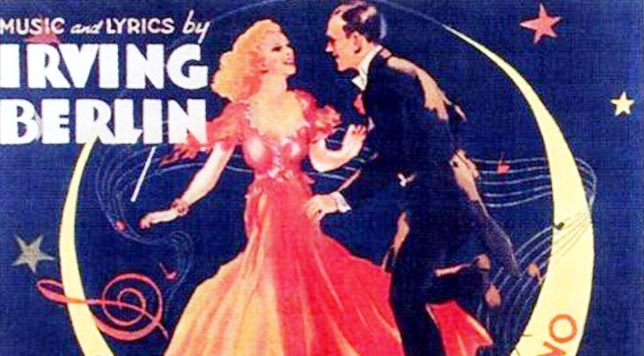
Carefree (1938). 83 minutes. Directed by Mark Sandrich. Starring Fred Astaire (as Tony Flagg), Ginger Rogers (as Amanda Cooper), Ralph Bellamy (as Stephen Arden), Luella Gear (as Aunt Cora), Jack Carson (as Thomas Connors), Clarence Kolb (as Judge Joe Travers), Franklin Pangborn (as Roland Hunter), Walter Kingsford (as Dr. Powers), Kay Sutton (as Miss Adams), and Hattie McDaniel (as Hattie). Choreography by Hermes Pan. Music by Irving Berlin.
Carefree is the seventh and shortest musical starring Fred Astaire and Ginger Rogers, featuring only four songs—all composed by master songwriter Irving Berlin. The plot follows a psychiatrist’s intervention in a woman’s lukewarm love life at the behest of her concerned partner, and the movie could easily be experienced as a comedy about therapy rather than as a standard Astaire-Rogers musical. The material is sexually offbeat, with a topsy-turvy master/subservient element: by analyzing intimate dreams and performing borderline-erotic hypnosis intended to remove his patient’s inhibitions, Astaire as the doctor in question mans a practice that is kinkier than we might expect in a post-Code movie, and Rogers as his patient kinks right back at him. There is even a bizarre bit of comic physical abuse thrown in for good measure. But as we contemplate how very weird these elements are, it would be wrong to overlook how beautiful Carefree—through its occasional singing and dancing—can be as well. Like many post-Code movies, Carefree is an example of how even after the advent of formal internal censorship in Hollywood, films could still exhibit that wonderful, strange pre-Code mixture of madcap fun and glorious loveliness that has the power to unnerve even as it entertains us.
In Carefree, lovestruck Stephen Arden (played by Ralph Bellamy) fears that his fiancée, radio star Amanda Cooper (played by Rogers), will not marry him, and so he seeks help from his friend, the psychiatrist Dr. Tony Flagg (portrayed by Astaire). Tony agrees to see Amanda, but upon their first meeting at his office, Amanda hears the preliminary notes that Tony has dictated about her on a shellac record, which are unflattering, and she rebuffs his efforts to help her. Soon, however, Amanda develops feelings for Tony. In order to get closer to him, she claims that she cannot dream, which leads him to conclude that she is neurotic. He uses anesthesia on her to release her inhibitions and cause her to get better acquainted with her subconscious mind, but she breaks free, spoils her radio performance, and wreaks havoc on the neighborhood under the influence.
When Tony discovers that Amanda is in love with him, he hypnotizes her to recommit to Stephen instead. He unhypnotizes her when she goes wild with a gun at a country club. Amanda and Stephen then prepare to be married. Tony realizes that he wants to be with Amanda and attempts unsuccessfully to re-hypnotize her (his efforts are thwarted by Stephen). Finally, Tony interrupts the wedding day in order to use his powers on Amanda and cause her to love him instead of Stephen. In the last shot, successful in having altered Amanda’s mind, Tony walks down the aisle with her to be married.
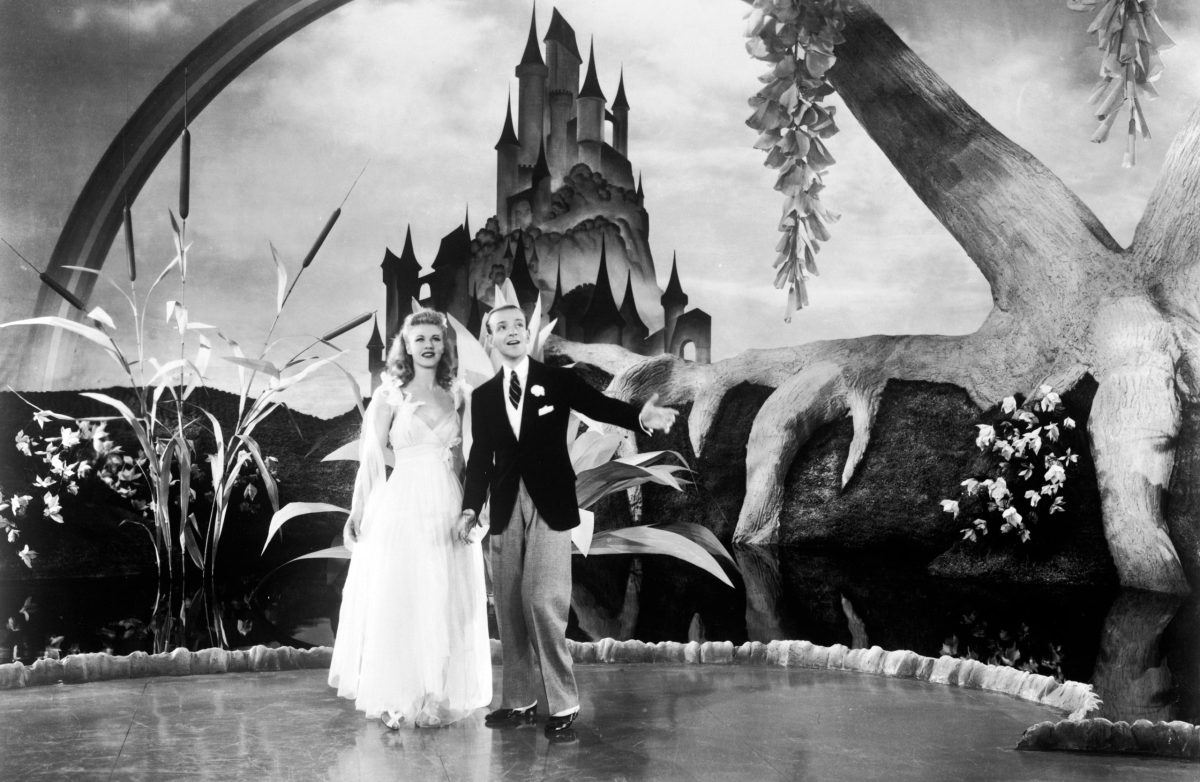
Unfortunately, Carefree is not as well-regarded for its music as other Astaire-Rogers movies, such as the glorious Top Hat (1935) (which features the heavenly “Cheek to Cheek” and “Top Hat, White Tie, and Tails”) or the much praised Swing Time (1936) (which includes “The Way You Look Tonight” and “Never Gonna Dance”), but there are some gems here. All of the songs were written by Irving Berlin, and one of his best in Carefree is “I Used to Be Color Blind,” which Tony sings to Amanda as he dances with her in a dream sequence. The dancing that accompanies this number, while not as iconic as the choreography of “Cheek to Cheek” or “Never Gonna Dance,” is simply wonderful. At one point, in delicious slow-motion, Rogers twirls around in her gown with Astaire as if it were a dancing partner in its own right. (Indeed, Rogers’s costumes always performed a kind of dance on their own, and “I Used to Be Color Blind” is a particularly good example of her talent for using everything at her disposal when she executed her steps.) As the song plays, Astaire and Rogers skip past enormous flowers and jump across huge lily pads in a fantasy outdoor set, coming dangerously close to falling into pond water. The effect is that the routine feels dynamic, dramatic, and even a little risky. The sequence was originally conceived of as a Technicolor piece and, had the plan to film in color been realized, would have been a rare example of Astaire and Rogers not dancing together in black and white. The fact that the dance concludes with the longest onscreen kiss between the two—the only kiss of theirs that is more than a mere peck—contributes to its value in the Astaire-Rogers canon.
But Carefree does not need the wow of the dreamy “I Used to Be Color Blind’s” intended format or that number’s protracted spit-swapping in order to be remarkable, for the choreography elsewhere is sufficiently novel, particularly in the dramatic “Change Partners,” where Tony manipulates Amanda’s movements like a hypnotist-magician. Tony controls her body as they dance as if she were a marionette—moving his hands above and around her, directing her steps often without actually touching her. “Change Partners” thus transitions us from traditional partner dancing to a kind of alternative, trance-like mode of movement, in which Tony directs the hypnotized Amanda as if he were a kind of Hermes Pan, the film’s choreographer.
In “Change Partners,” Tony dramatizes through dance the general sway that psychiatrists hold over their patients. His interaction with Amanda in this scene also suggests the power of male dancers, traditionally the leads in couples dancing, to guide a performance and, by extension, commandeer their female counterparts. We might be tempted to conclude that in a way, just as Tony triumphs over Amanda, the conceit of “Change Partners” allows Astaire to triumph over Rogers for the length of this dance, but also points to his dominance in the relationship for the whole of their lives. In some regards, his success did outstrip hers: she won an Oscar before he did (for 1940’s Kitty Foyle), but he was paid more during their years of collaboration, he is the one who had the worldwide recording career, and he left his footprints in cement at Grauman’s Chinese Theatre in Hollywood before she did. We might even conclude that their relationship was designed to give Astaire the upper hand—his surname is the first word in the name of their act, after all.
But in retrospect, it is always difficult to think of Astaire dominating Rogers, even when her character is hypnotized. This is in part because of her strong and compelling performances, but also because she famously remarked at one point in her career that although Astaire was often perceived to be the star of their routines, she executed all of his dance steps herself, only backwards—suggesting that her work was even more challenging and noteworthy than his. “Change Partners” ultimately leaves the issue of which dancer is most powerful up in the air, and it is important to acknowledge that; for the song is about partnership rather than competition or struggle, and partners, including dance partners, are in some regards always on equal footing, whether they are gliding along cheek to cheek or barely touching hands.
Whereas “Change Partners” is elegant and refined, “The Yam” sequence is unbelievably silly. Astaire would allegedly not sing this song in Carefree, rejecting it as being undignified, and in the movie he only kind of talks a couple of its lines in recitative at one point (the task of singing the lyrics falls to Rogers). Nevertheless, Astaire recorded a version of the song with band leader Ray Noble in the year of Carefree’s release, even performing a separate, related number on the reverse side in which he discusses the Yam dance with Noble, provides instructions on how to execute its steps, and is heard hoofing away on the floor. How Astaire was persuaded to make this recording, plus the bonus side, is unknown to me.
In the movie version, Rogers demonstrates the dance accompanied by a band, singing ludicrous instructions for how to perform the moves of this purported root vegetable novelty fad such as “wave your hands and sway/like you hold a tray/then you’re on your way–YAM!” At one point, she croons, “Come on shake your depression/and let’s have a yam session.” There’s nothing quite like a reference to the gloom of the Great Depression to get your song moving along, but “The Yam” is a resilient little spud. Rogers does manage to pull Astaire onto the dance floor with her at one point so that they can swing on out together. They proceed to dance all around the country club (where so many of the film’s scenes are set), arm in arm, with him tossing her into soft, cushiony armchairs and her bouncing up onto the floor again.
It is as close to a kind of dance craze song as 1938 could come to, not nearly as demure as the earlier “The Continental” (sung by Rogers in the second Astaire-Rogers film, The Gay Divorcee [1934]), but then not everything has to be. “The Yam” is a peculiar entry in the Irving Berlin songbook and in the Astaire-Rogers canon, but I have to say it is one of the high points in the movie for me, and Astaire’s recording of it on shellac is one of the most fun dance band records of the late 1930s. “The Yam” demonstrates just how silly the two performers could get, and in a movie that is largely about psychology, it is a pleasure to be reminded of just how nutty the human psyche can be.
We might be tempted to overlook the storyline in Carefree in favor of its dancing, but the movie’s plot, with its focus on psychiatry, is at least as intriguing as what Astaire and Rogers are doing with their feet. Like the later Now, Voyager (1942) and Spellbound (1945), Carefree shares in the psychiatric conceits common to cinema from its era: talk therapy, dream analysis, allusions to the conscious and subconscious minds, and hypnosis. Dr. Tony may burst into song occasionally, but he also has a proper clinical office, a waiting room, and an exam room where he can treat people like Amanda, who has, per Tony, “the most beautiful case of complex maladjustment.”
Yet Carefree as a comedy presents us with a goofy movie version of psychiatry, with Dr. Tony enthusiastically using cornball clinical expertise to treat a patient whose lies he is not sharp enough to see through. Tony takes the study of the human psyche and makes it seem deliciously frivolous. Falling back on the fluffy language of lame popular self-help, he attempts to convince Amanda that his services are useful. Through a quick play on words, she turns Tony’s professional outreach into the empty rhetoric of a cheesy crank:
Tony: I wish you’d please understand that I’m only trying to help you find yourself.
Amanda: Well, if I ever get lost, I’ll call on you.
His association with weak-sauce medicine is captured in a visual gag when the two characters take a bike ride together and he ends up falling into a pond full of ducks, who quack away at him. For a moment the movie jokingly aligns him with actual ducks as if he were one of them—an esteemed representative of healthcare who is nevertheless really just another fowl making noise in stagnant water. Tony may have an advanced degree, but he also has one foot in the animal kingdom. Carefree therefore seems to agree with Amanda: the talk of someone who is a borderline pop psychologist like Tony might be highfalutin, but his sentiments are as silly and insubstantial as a handful of feathers.
This is all part of the setup for the classic Astaire-Rogers I-hate-you-therefore-we-must-be-in-love motif, in which the two characters get off to the worst conceivable start, only to fall madly in love with each other later on. Before he meets Amanda, Tony dictates his preliminary observations on a recording device as he preps for his first session with her, and they are not flattering:
There’s a Miss Cooper waiting for me. She’s another one of those dizzy, silly, maladjusted females who can’t make up her mind. I’ll probably find out she hasn’t got one.
Tony eventually recognizes that he has developed feelings for her after having a conversation with himself in a mirror, snapping out of disdain and into love in a mere moment. But Amanda experiences her transitions through more artificial means. His prescription for her love life is simply to switch her feelings from off to on through a whiff of medical gas or a hypnotic blinking light in a dark exam room. As a result, the psychiatric world in Carefree appears not only to tolerate either/or, bipolar thought patterns but to embrace them as part of a course for getting well—fully affirming the validity of those patterns.
Tony’s medically sanctioned psychiatric techniques are more than a convenient form of moving the two characters through Carefree’s topsy-turvy romance. They are the ultimate way for the whole Astaire-Rogers franchise to normalize its characters’ generally borderline romantic disorder. By medicalizing Amanda’s emotional fluctuations, Carefree implicitly works to convince us that the usual black/white back-and-forth of Astaire and Rogers on screen is a normal, healthy way of interrelating with our partners. In Carefree, the characters’ stereotypically dysfunctional dynamic actually proves to be less of a problem and more of a virtue. It may be surprising to see a movie about psychiatry emphasizing the legitimacy of such an erratic approach to relationships, but it is also surprising that it took until 1938 for the Astaire-Rogers franchise to figure out the ultimate justification for romantic problems that might otherwise cause us to caution two lovers, either on or off screen, that it might be best for them to change partners and part ways.
Carefree may ostensibly be about a professional relationship, but the movie is actually pretty kinky, especially for a post-Code film. For starters, Dr. Tony actually prescribes a little BDSM to one of his female patients:
Dr. Jones, I am turning this case over to you for further treatment. My observations are as follows: She’s a typical pampered female. What she needs, instead of a doctor, is a good spanking.
Dr. Jones (or some other man) may be the one advised to administer that particular, potentially licentious punishment, and the unnamed woman may or may not happily submit; but Tony finds his own opportunities to playfully lead Amanda to health, sans paddling but with a fair amount of deviant fun. In a way, he takes charge of her physically through a sort of sexual power play—at one point whisking her into his exam room and causing her to lie prone and vulnerable on a table while he drugs her. “Try to make your mind a blank,” he instructs her as he attempts to wipe away her thoughts and replace them with his own. He also sends his assistant Connors over to her apartment one night in order to openly administer a sedative. (There are weird undertones of substance use in this film: Amanda’s fiancé Stephen spends the first part of the movie so under the influence that he must be walked in circles by Connors in Tony’s office to stave off the dangers of drunken sleep.)
Together, Tony and Amanda make psychiatry a romantic game. Because Amanda says that she does not dream when she sleeps, he accompanies her to dinner and guides her eating so as to produce interesting nighttime fancies. He gleefully encourages her to eat repulsive food: lobster with gobs of mayonnaise, cucumbers covered in buttermilk, shrimp cocktail with whipped cream—accompanied by strawberry shortcake. Perhaps Tony is getting his idea for how dreams work from an old Renaissance treatise on how the stomach affects the humors, but in any case his exploitation of the gut-mind connection is another manifestation of his quirky, dom-like behavior.
In the spirit of play, Amanda genuinely appears to enjoy all of this. After Tony has unleashed her subconscious mind as part of her treatment, she relishes running around as the embodiment of the human id, causing mayhem on the streets in the absence of any inhibitions. She enthusiastically manufactures a dream for Tony to analyze, choosing to make use of the psychology of the red riding hood folktale, with its endangered little girl motif. (True, she asserts that she was the wolf in the dream, not red riding hood, but her association of herself with the panting, ravenous wolf is at least as suggestive.) As part of the dream—she says, lying—she became a radio dial: “It seemed that all night long, there were thousands of people that kept turning me off and turning me on and turning me off and turning me on,” she relates, using the double entendre “turn on” to indicate both the mundane act of switching a radio on and an excited state of sexual arousal.
Even Aunt Cora eventually gets involved in the fun when she remarks, “I wouldn’t mind being analyzed by [Tony] on my bicycle. Or on anything, come to think of it.” Aunt Cora, it is lightly implied, may be open to multiple sexual positions, and of course the bicycle figures prominently in old dirty jokes about stimulating women (such as the extended bawdy conceit in the song “She Jumped on Her Push Bike and Pedalled Away”). Cora also flirts with Connors and allows him to drug her instead of Amanda for who knows what reason, and she appears to be embroiled with Judge Travers as well. So Tony and Amanda, as well as Aunt Cora, spend most of this movie implicitly teetering along a thin sexual boundary. The boundary is kept in place by virtue of the Production Code and its strictures, but Tony and Amanda are always close to saying something explicit that could get them into trouble.
Carefree’s dominant/submissive overtones are a laugh, but there is also a more uncomfortable aspect to them. At the end of the film, Tony conspires with Connors to obtain a few minutes with Amanda on the day of her wedding to Stephen; Tony’s plan is to hypnotize her one final time and cause her to believe again that she loves him. To facilitate Tony’s objective, Connors observes that they could easily intervene in Amanda’s big day through force: “I’d get her unconscious in under five minutes. I’d bust her in the jaw. I guarantee she’d be unconscious.” Tony intends to hit her himself, while Amanda is dressed in full wedding regalia, no less. He finds cannot do it, but Stephen takes a swing at Tony and accidentally hits Amanda instead, knocking her out cold. Crouching near her on the floor of her dressing room while she is out of it, Tony directs her through the power of suggestion to repeat that she loves him, and she does so with a look of ecstasy on her face. The shot cuts to the outdoor wedding set, where we see Tony walking with Amanda down the aisle, both of them smiling—she with a big black eye.
The face slap at the end of Carefree reminded me of the conclusions of the pre-Code movies Smarty (1934) and The Big Broadcast (1932), which both embrace physical assault as either a necessary ingredient in romance or as a means for a cheap laugh (respectively). In The Big Broadcast, Bing Crosby (playing himself) implicitly assaults his fictional girlfriend Mona when the camera cuts away in one scene, giving her a black eye that she appears with in the story’s final moments. Neither Crosby nor Mona are under the influence of hypnosis in The Big Broadcast, but Mona’s black eye is clearly intended to work as a kind of punchline, and the same can be said of Amanda’s bruised face at the end of Carefree. Whatever the intentions of either movie are, the women’s faces are hard to look at.
Equally squirm-inducing is the fact that Amanda is still under the sway of the thoughts planted in her head during hypnosis when she marries Tony. She appears to be overjoyed, but she is not fully in control of her faculties. Will she ever shake the force of hypnotic suggestion? For Amanda, her treatment under Tony never really ends, not even when she is walking down the aisle with him. The whole thing has the potential to produce a resounding “ew” that might cause the audience to rethink how carefree Carefree really is.
No matter what the context, Astaire and Rogers dancing together feels like a kind of cinematic miracle—preserved on celluloid for as long as movies will last, and always animated with a kind of life force that surpasses their films’ relationship to time. In this movie, however, their musical performances cannot override the pervasive sense that this story about the science of the mind is a little bit nuts. Dances like “I Used to Be Color Blind” and “Change Partners” may fill the screen with supreme elegance; but “The Yam” speaks more directly to the crackpot nature of Carefree and its rejection of Astaire’s top hat, white tie, and tails in favor of something more offbeat.
Tony and Amanda get to enjoy a bit of both worlds, both the beauty of cavorting together and the funkiness of their lives when the music stops. They will glide into their future together and enjoy wedded bliss, and perhaps Amanda will never understand that her participation in that future is influenced by hypnosis. But we know that their love for each other will ever be conditioned by a trick of the mind that undermines the honesty of their relationship. Although we might laugh and enjoy the boisterous plot, we would be crazy not to wriggle at the movie’s premise with some modicum of uneasiness. For Tony and Amanda’s journey down the aisle is as lunatic as it is amusing, and we hardly need a doctor’s intervention to convince us that Carefree’s medicine is really about trading one kind of madness for another—about liberating us from the chains of psychosis so that we might ironically thrive as the cringey kooks we truly are.