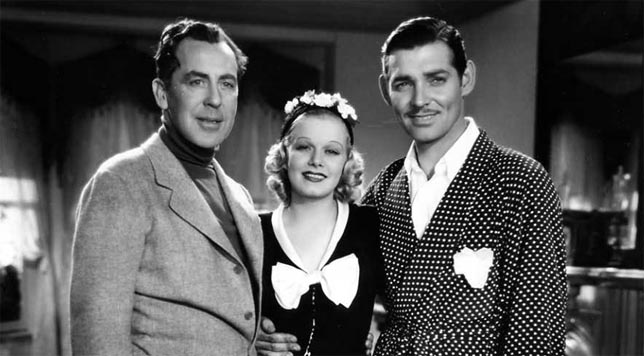

Red Dust (1932). 83 minutes. Directed by Victor Fleming. Starring Clark Gable (as Dennis Carson), Jean Harlow (as Vantine Jefferson), Mary Astor (as Barbara Willis), Gene Raymond (as Gary Willis), Tully Marshall (as “Mac” McQuarg), Donald Crisp (as Guidon), Willie Fung (as Hoy), and Forrester Harvey (as Captain Limey).
Those in search of the quintessentially sultry Hollywood romance will not be disappointed by Red Dust, a sizzling pre-Code drama that focuses on a ménage à trois in Indochina, now known as Vietnam. There on a rubber tree plantation, red-hot Dennis Carson has his hands full with two women—Vantine, who is possibly a prostitute, and Barbara, the uptight wife of one of Dennis’s workers. The balmy Vietnamese backdrop against which Red Dust’s melodrama unfolds both mimics and fuels these characters’ romances. The action is over the top, with a fair amount of yelling, face slapping, and boozing, and the film’s sexy subtext is so charged that it seems to almost jump right off the screen. Given the pre-Code context, the movie’s sexual themes are perhaps not surprising, but for any era, Red Dust is a masterclass in how to get away with a little (or a lot) of everything that’s scandalous and subsequently push an erotic drama to the hilt.
Red Dust begins with the arrival of Vantine on Dennis’s rubber tree plantation. Having apparently been chased out of Saigon, she comes to stay at the plantation on her way to parts unknown. It is the only domicile for miles. There she and Dennis get off to a rocky start, but soon they are lovers. When Vantine boards a boat to leave a month later, Dennis says goodbye and gives her a handful of money.
Soon Barbara and her husband Gary arrive at the plantation; Vantine also pops back into Dennis’s life after her boat breaks down and she returns to stay with him. Gary is there to labor alongside Dennis, but Dennis, rather than focusing on this collaboration, has his sights set on Barbara. He sends Gary away to manage the far end of the plantation territory and works on seducing Barbara. Soon Dennis and Barbara embark on a torrid affair. With plans to break the news to Gary and send him away permanently, Dennis journeys out to where Gary is working but sees how devoted he is to his wife. Back at the plantation house with Barbara, Dennis lies and tells her that he never loved her, then in front of Gary claims that he has been pursuing his wife all this time but that she has resisted his advances. Feeling betrayed, Barbara shoots him and leaves with Gary. In the last scene, we see Dennis recovering from his gunshot wound with Vantine, laughing and finally alone again with her.
Red Dust’s plantation in Indochina is the steamy setting to end all steamy settings. The wild, hot monsoons that bring down torrents of rain upon the characters threaten their survival and turn up the heat in their relationships. One such impromptu storm is the perfect melodramatic metaphor for the eroticism of Dennis and Barbara’s burgeoning relationship, and occurs when the two are out on a walk and flirting with each other. Caught off guard by a sudden change in the weather, they begin to sprint in order to reach the plantation house but are nearly swept away by strong winds. Barbara loses her hat and turns to recover it, but Dennis shouts that she must keep running. Soon they are both wet, with clothes plastered to their bodies, and he-man Dennis is carrying Barbara in his burly arms as he runs like lightning to reach the shelter. The setting hurtles the two characters towards each other physically while externalizing their intense attraction to each other in the form of nearly carnal weather.
It is not a stretch to say that in this environment the characters are driven by an at times animal lust. Dennis and Barbara practically pant after each other as they dance through the steps of their illicit courtship, and Vantine’s pursuit of Dennis is charged with a similar desire. Consider also the actual animals that we see in the plantation’s habitat—a predatory tiger who is stalking humans and must be hunted in the dark of night, or a squawking bird who must be contained in its cage regardless of how large it is, lest it should fly back into the jungle. How different are these creatures from their human counterparts? Like a cat himself, Dennis stalks first the feral Vantine and later Barbara, much as he does the tiger. The glimpses of the wild world of the jungle that the movie affords us underscore the extent to which Red Dust’s human energies are similarly untamed.
To drive home the animal subtext, in a truly bizarre scene we see Vantine cleaning out her bird’s cage, scraping away excrement while Dennis’s servant Hoy shows her the underwear that he is laundering for Barbara and laughs at how frilly the garments are. By oddly juxtaposing the exhibition of Barbara’s lingerie with the open display of the bird’s biological processes, the scene reinforces Red Dust’s blatant affiliation of human romance with the local wildlife. In this wonderfully bewildering and tasteless display, however, the bird droppings also work as a more focused conceit that naturalizes and even justifies the characters’ impulses. Barbara’s risqué sexual artifact and the rude product of the animal’s bodily functions are pictured as physically adjacent entities, both related to urges required for life: much as the bird gives in to its essential needs, the way that the protagonists succumb to their intimate desires is similarly necessary. The cage-scraping scene therefore supports the premise that Vantine, Barbara, and Dennis are not exactly deviants—even though one of them appears to be a loose woman, one is cheating on her husband, and one is an unrepentant womanizer. Instead, the characters behave the way they must, motivated by a drive that is as intrinsic as it is coarse. Indeed, inhibition, emotional restraint, and physical self-control are not qualities that are rewarded on the plantation of Red Dust.
Speaking of frilly underwear, I should note that there is a lot of bedtime attire in Red Dust, which begs the legitimate question: how many robes can two women own? Both Vantine’s and Barbara’s suitcases are tiny, but they are seen wearing a fresh silk or satin robe each time we see them indoors. For the most part, the style of their robes is such that they must wrap one side over to the other side and hug it there without a tie or fastener. The result is that they are always holding their hands across their own waists, so that even their fashion argues for the necessity of physical embrace.
The women, however, are not always clothed in sexy evening wear. In one famous scene, Vantine takes a bath in a water barrel on a balcony where everyone can see her; she understands this and teases Dennis from the tub.
Here the legendary fluffy, wavy, platinum-blonde Harlow hair is wet and plastered to her scalp, and she cracks wise with Dennis while she bathes. It is as if Harlow is undoing her stylish, carefully maintained bombshell image before our eyes—with no perfect coiffure, no glamorous gowns, and only minimal makeup as she splashes around. Moreover, as she lathers her body and hair, we become keenly aware that Harlow as Vantine is at the very least topless, and if the camera were to creep slightly in any direction, it could produce an explicit shot. In a moment where Harlow’s physical body and her elegance are both stripped, the essence of her sexual persona is nevertheless on full display. The bathing scene in Red Dust must be one of her most erotic appearances in any movie.
Dennis reprimands Vantine and pulls the blinds down around the bath, agitated by her nudity and concerned that she is making Barbara uncomfortable from across the way in the compound. But that is the whole reason that Vantine is behaving in this way—to excite Dennis and make the prudish Barbara squirm. In this particularly meta moment, Vantine becomes a kind of actress in her own bathtub cinema, fully embracing the provocative nature of so much of pre-Code film with its proclivity for scandalous and enticing content. And much like critics of pre-Code movies, Dennis lashes out at the show that Vantine is putting on due to the nature of her prospective audience. For Dennis, the possibility of Barbara seeing Vantine’s nude performance is a real danger—both to Barbara’s sensibility and to his quest to convince her that he is an upstanding guy, the kind who does not have a prostitute from Saigon holed up with him in his balmy plantation house. Like a censor, Dennis strives to prevent Barbara from being exposed to the lewd display on his terrace. But look at what Vantine’s exhibitionist behavior produces: shortly after this scene, Barbara gives into Dennis’s sexual advances as a convert to Vantine’s wild way of living and loving. Barbara learns something from Vantine in this movie even if she does not openly acknowledge Vantine as a source of inspiration or encouragement.
It is not just the women who appear in intimate attire or are semi-naked. There is a sequence that shows Dennis undressing, largely off camera, as he gets ready for bed, throwing off his shirt, his pants, and eventually his underwear. In a provocative moment, Vantine, who is in the room with him, pulls off his boots as he sits on the bed shirtless. Stripping Clark Gable down to his bare chest was not an uncommon practice in the movies—it also notably occurs in It Happened One Night (1934).
But in both movies, rather than having the effect of making Gable appear vulnerable, his undressed state seems to make him more powerful. The state of undress naturally reveals more of his body, and thus we view his strong build, his powerful arms. Given that Dennis is largely in control of all his relationships in Red Dust, both with women and with men, it is hard to resist seeing his nude torso and not think of how it works in tandem with his commanding personality. Even after Barbara shoots him and he recovers with Vantine, he directs Vantine to stick an iodine-laden swab into his bullet hole and push it out of the other side of his body. With his shirt open, he reacts to the treatment with a minor expression of annoyance and a minimum of pain, still entirely in command of both his body and what is happening to it. There appears to be little room for vulnerability in Dennis’s character, unlike in some of Gable’s other famous roles. His Rhett Butler in Gone with the Wind (1939) may ooze self-confidence, for example, but Rhett is broken by the death of his young daughter Bonnie and actually cries. It is difficult to imagine what would break Dennis, and his over-the-top manliness is just as much a part of the sexualized energy of Red Dust as any of the lingerie we may see on the women.
The scenes where we see Dennis most aggravated are all related to the business of his plantation. In the vein of novels that explore human dramas while providing factual side notes on science and natural processes—such as Herman Melville’s Moby Dick with its technical chapters on whaling, or Graham Swift’s Waterland with its excurses on eeling—Red Dust works its way through its central erotic action while paying a surprising amount of attention to the details of rubber-making. Dennis draws rubber from tapped trees, actually drinks raw rubber liquid as it drips from bark, and spits it out in disgust; the trees are too young, he says, and they are not ready to yield the product. Later we see Dennis demonstrate the rubber-making process for Barbara, pouring the white liquid into a tray, mixing it with acid, and pulling up a raft of hardened material. Workers roll the rubber in a press, creating thin sheets, which are then hung up to dry. There is an odd shot of Barbara and Dennis standing in the production room, observing the drying sheets.
Later with his overseer Mac, Dennis discusses his purpose at the plantation, his life’s work. Is it worth it, all of this labor and sweat, just to make hot water bottles for old dowagers? Or rubber bottle tops for babies to suck on? Both of the examples that he produces involve women—either women in old age feeling the cold or (presumably) younger women nursing babies with bottles. That their minds stray towards the topic of women using the fruits of the plantation’s labor in such personal ways reveals that there is a sex dynamic even in something as industrial as rubber-making.
The reality is that for Dennis and his colleagues, there is a nasty side to rubber production and to the plantation. Dennis’s mother died there of a cause unspecified. But we know enough to guess that her life was as hard as Dennis’s. No one could be more enthusiastic about working there than Barbara’s husband Gary, but Dennis and Mac think that, while Gary has good energy, he will not make it out there among the trees.
It is a hard life, but if we acknowledge that much about Dennis and his overseers’ lives on the plantation, we should acknowledge that the difficult nature of the work is at least doubly true for the Vietnamese workers who toil there. We repeatedly see them rounded up, pushed, and shouted at. Even when Dennis is not directly yelling at them with ferocity, he is shown barking aggressively in their direction. What is their story? What are their own evenings like at their own houses? There do not appear to be women among them. Might they not have their own Vantines and Barbaras back home? Even though we see the Vietnamese workers all throughout the movie, their narratives are kept hidden from us.
We do see one Vietnamese worker up close: Hoy, the house servant. Hoy laughs at his white employers, at himself, at his own cooking, and even at the laundry, giggling and shouting the inane “Peep peep!” whenever he trespasses on a delicate moment or witnesses something that he ought not to see. He cannot make the biscuits that the household desires, and the results send him into a fit of laughter. The biscuits turn out raw in the middle, stretchy and melty on the inside like string cheese—so, Red Dust asserts, Hoy cannot successfully adapt to white culture.
Hoy is just about as close as this movie can come to giving a Vietnamese person a more fleshed-out character, but the cringe factor associated with his appearances is greater than any benefit there might be to having him as a counterbalance to the protagonists. As an always jolly servant, he has no discernable depth, and overall his presence, which is likely there to provide comic relief, is usually inappropriate, mostly utterly absurd, and always gross. He serves as a good reminder that the gravity of non-white people in the worldview of old Hollywood (and even pre-Code Hollywood) was significantly limited because, by extension, in wider U.S. culture their gravity was also perceived to be limited. Ultimately the cultural sentiments of movies like Red Dust supported already existing racist beliefs that the lives of people of color were not as complex, beautiful, or varied as the lives of white people.
If Red Dust is to be enjoyed, the movie’s healthy serving of racism must be dealt with, as must a plethora of additional unpleasant details. How many times are characters physically aggressive, for example? Whether it is Dennis shoving Vietnamese workers, Dennis slapping Vantine, Vantine slapping Barbara, or Vantine slapping Dennis, there is a lot of battery in this movie, but the characters treat it as if it is all a part of a day’s work. Even when Dennis is shot in the finale, he plays it off as if it happened every day. Red Dust reminds me of a primetime soap opera from the 1980s, where slaps and catfights were de rigueur. But the protagonists here hurt each other emotionally, too—such as when Dennis parts with Vantine at the docks and insists on paying for her services while she stayed at his house (even though she is in love with him) or when Barbara delights in her betrayal of Gary. The characters’ abuse of each other is both melodramatic and, for better or worse, part of Red Dust’s appeal.
Psychologically, Red Dust has its own brutish qualities. Apparently, in the extremes of environmental heat comes extreme behavior, and you are either a character who is slapped or a character who slaps—it is all very black and white. Dennis either loves you or doesn’t love you. He either thinks you are a prostitute and pays you for staying with him as a lover for a month, or he identifies you as a saintly, pristine woman—chaste and untouchable, gloved in white and keen to be swept up. It is either off or on; there is no in-between in this movie. Red Dust at first dangles the possibility that some kind of threesome might develop among Dennis, Vantine, and Barbara, but by the film’s conclusion, it is clear that, like so many other things in the movie, it is one or the other.
In the final scene, Vantine and Dennis seem to laugh everything off as she sits there reading him bedtime stories from the newspaper. Dennis’s guests have departed, weary and fooled. Gary thinks his wife was attacked by Dennis. Barbara, believing that Dennis never cared for her, gets to remain “Babs” to Gary and retain her purity in her husband’s eyes. They pack up their tennis rackets and go home. Vantine and Dennis escape, too, but they escape with each other—the prostitute caring for the cad, the cad smiling through his recovery from the gunshot wound. The wound does not seem to be a comeuppance for anything.
The plantation remains a paradise for the two of them and their heated relationship, the red dust piles up outside, and the rain washes it away. Like the dust, Barbara and Gary are a passing fancy, a momentary illusion that can be shaken off. But Vantine and Dennis are the monsoons: dramatic, powerful, governed by a force of nature. Just as the boat comes once a month and then departs, so, too, is Vantine and Dennis’s love story always a tenuous union. They endure nonetheless. Barbara may have been momentarily swept up by the passion of the plantation, but this place is where Vantine and Dennis belong, and here they will apparently remain with the scoundrels and the drunkards, in the sweat and in the rain, cycling through a never-ending weather pattern together for as long as the rubber flows.