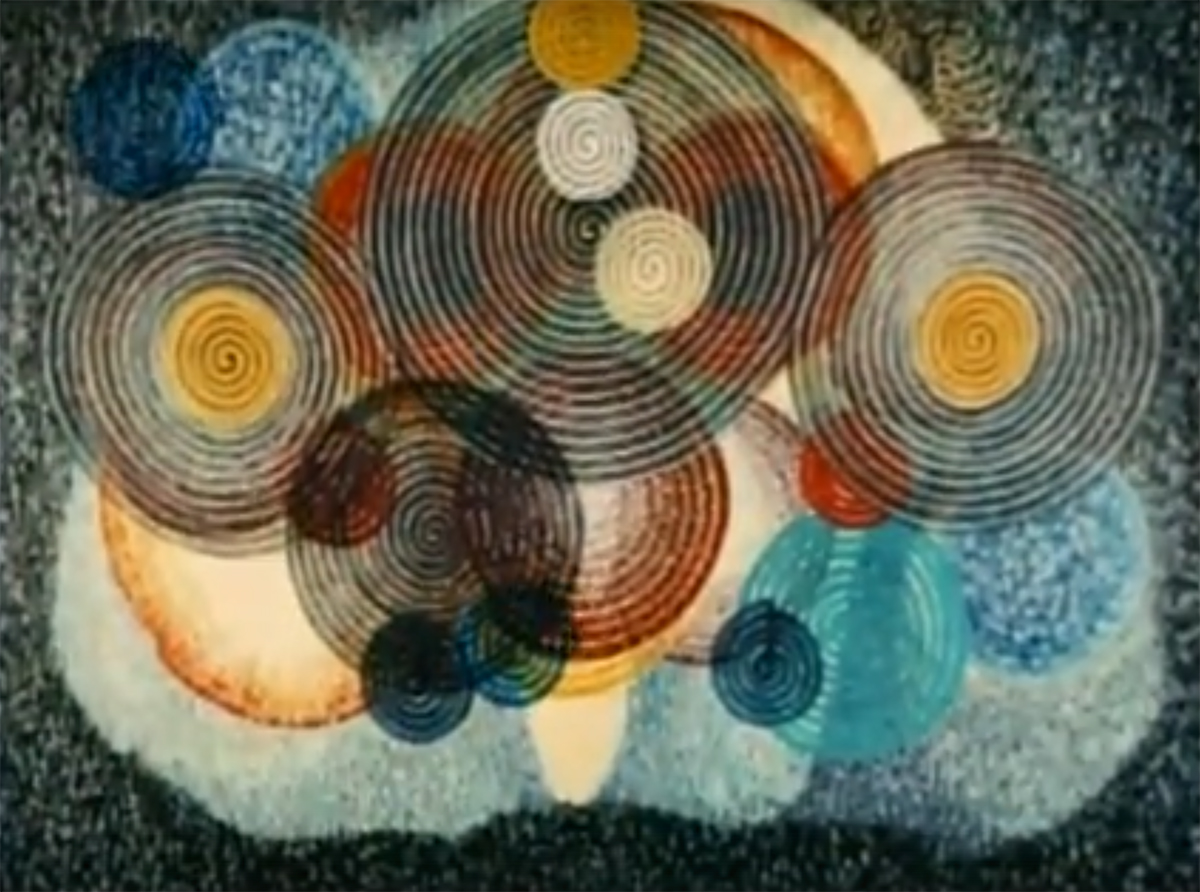
Motion Painting No. 1 (1947). 11 minutes. Directed and painted by Oskar Fischinger.
Motion Painting No. 1 is an abstract expressionist film in which, through stop-motion photography, experimental artist Oskar Fischinger creates a series of layered, painted geometric shapes that appear to move by themselves on a plexiglass surface. The film is not the first to feature solely abstract shapes (for other examples, see Synchromy No. 4: Escape [1937] by Mary Ellen Bute, or Kaleidoscope [1935] by Len Lye); it is also not the first film in this milieu that Fischinger himself created. But Motion Painting No. 1 is considered not only to be a crowning achievement in Fischinger’s career but also to be a landmark intersection between oil painting and the big screen. Of course, an abstract expressionist aesthetic—even in a movie that is lauded as one of the greats—can be challenging to appreciate, especially when its audience is accustomed to watching narrative film. Fortunately, as a sort of proto-music video and an anticipator of the modern computer screensaver, Fischinger’s film is actually more accessible than we might expect, and because it consists of shapes only, it still feels fairly fresh eighty years later.
In the 1920s, in his native Germany, Oskar Fischinger began his professional career, as did so many early filmmakers, as an engineer and tradesman, and later in the decade branched into movies as a developer of special effects. For example, in the Golden Age of silent film, he developed a portable, guillotine-like device that sliced wax from a block in sync with the camera shutter, progressively revealing shapes. The makers of The Adventures of Prince Achmed (1926)—the earliest surviving feature-length, fully animated movie—intended to use his device to create the film’s opening sequence, but the slicer failed to perform successfully because the wax melted under the hot lighting in the studio. Much later, in Hollywood, he invented the Lumigraph, an instrument that manipulated light partially hidden behind a screen to create abstract color images. This complex tool required two people to operate, one to manipulate the screen and the other to change the lights; it was eventually used in the film The Time Travelers (1964). Many of Fischinger’s inventions were at home in fantasy- or science fiction-related projects, such as Fritz Lang’s Woman in the Moon (1929).
But as was the case with The Adventures of Prince Achmed, Fischinger’s career was filled with rejection and frustration. In his native Germany, his style of art even became dangerous to engage in; like many German creatives, in the 1930s he fled the Nazis, who persecuted so-called degenerate artists, including abstract expressionists. In the U.S., although he eventually had limited success with devices such as the Lumigraph, his Hollywood career never really took off. He worked on the film Big Broadcast of 1937 (released in 1936) for Paramount but quit over creative differences. He left the Disney production of Fantasia (1940); his work on the movie’s abstract animated opening for Bach’s “Toccata and Fugue in D Minor” was ironically deemed to be too abstruse. He also left Disney’s Pinocchio (1940) at around the same time.
Throughout his filmmaking career, Fischinger was a practicing painter. He found support for his art in the 1940s, specifically from the Museum of Non-Objective Painting (now the Guggenheim). His work outside of the Hollywood system came to encompass films that consisted solely of the creation of abstract images using stop-motion techniques, and ultimately resulted in Motion Painting No. 1, which won the Grand Prix at the Brussels International Experimental Film Competition in 1949. In total, Fischinger made more than 50 short films and painted hundreds of canvases, which can be seen in museums today.
Even though Motion Painting No. 1 is a dynamic, non-stationary work of art, we should feel comfortable transferring some of what we can observe about traditional static painting to the film. For example, we might observe that Fischinger is not afraid of color and uses a palette that ranges from cream and dark brown to deep turquoise, purple, and bright red. Additionally, we probably notice that Fischinger’s brushstrokes are precise and neat, resulting in tight spirals as well as straight lines rendered completely at right angles. And because Fischinger layers paint in Motion Painting No. 1, the film has an almost textural feel, with the plexiglass surface at times appearing to be thickly covered like some canvases.
But unlike a framed picture hanging in a gallery, Fischinger’s painting evolves in front of us and invites us to appreciate it as an animated film. We watch his multi-colored shapes come to life on top of the background and each other, either one at a time or in concert with other figures. Sometimes shapes sit in the same place as they grow, without traveling (for example, stationary triangles that resemble pyramids), and at other times they glide across the screen (e.g., teardrops that move like rain in reverse). Eventually the development of the figures becomes so intense that the screen nearly transforms into a void: I am thinking of the passage where Fischinger repeatedly layers black and almost-black spirals over each other, gradually creating a nearly empty screen that through its absence of color has the potential to bring about an end to the film. Then suddenly the canvas is painted over with white, and colored shapes begin to appear again. At the film’s conclusion, rainbow waves consume the screen in prismatic overwhelm. Any static painting could depict either the darkness of nothing or the color of life, but the motion of Fischinger’s canvas is what enables the film to depict near extinction by darkness, a subsequently bright ending, and the transition between the two.
As we watch, we might perceive how the shapes move to Motion Painting No. 1’s soundtrack, Bach’s Brandenburg Concerto No. 3, as if the two were genetically related. (Indeed, Motion Painting No. 1 has a name very much like Bach’s Brandenburg Concerto No. 3, suggesting that the two pieces were descendants from the same creative source.) Bach’s concerto is full of patterns and repetition, actions and reactions—worked through with a mathematical obsession similar to Fischinger’s painting. Indeed, so fluidly do Fischinger’s images move with what appear to be cues taken from the music, that it is hard to believe the images were not deliberately synchronized with their soundtrack from moment to moment. In the film’s 11 minutes, the two works are so closely aligned that they might seem dependent on each other for meaning: the geometric logic that we hear seems to drive what we see, and the images we see also seem to drive what we hear.
Yet we must recognize that, if we perceive a synchronicity between the film and the music, we are connecting visual patterns with something outside of themselves. With or without the soundtrack, if we find reason or logic in abstract shapes, then that is a way of understanding the shapes, but it is also an instance of us grafting something onto them—not something that resides innately within them. However open we may attempt to be when watching the film, and however much we may attempt to take in the images for the abstractions they are, the mind gravitates towards understanding the logic behind Fischinger’s shapes. Indeed, it is hard to look at the abstractions and not see representations of objects that correlate with life off of the canvas.
Observing the geometry of the abstractions is a helpful first step in appreciating the film. Here are some of the shapes I observed (in order of their appearance):
-
- diamonds
- small squares
- teardrops
- loops
- helixes
- tightly painted large and small spirals
- tightly painted spirals with protruding straight lines
- dashed lines (horizontal and vertical)
- dashed rectangles
- triangles
- straight lines that connect shapes
- centered circles
- large round curves in waves
And here is what they reminded me of (also in chronological order):
-
- diamond solitaires (from engagement rings)
- drops of water
- corkscrews
- intrauterine devices
- Chinese lanterns
- mid-century atomic dinnerware patterns
- pixels
- ocular irises
- music records with tone arms
- human breasts
- pinwheels
- lollipops
- spider webs
- honeycombs
- circuit boards
- notecards
- a brick wall
- stars
- candle flames
- windows
- punch cards
- timecards
- library cards
- trees
- houses
- mountains
- Egyptian pyramids
- skyscrapers
- blinking eyes
- the black hole at the end of a Looney Tunes cartoon
- rainbows
- heat maps
Your own list may look like mine, or you may see other shapes and make different associations. Some of the correlations I made are likely rooted in my own psychology, my own experience of the world, and my own experience of art. As is the case with Rorschach blots, a lot of what we perceive in abstract expressionism resides in our own unique mental configurations. But it is safe to say that I am not alone in my tendency to understand what I saw in terms of things that I already know, however idiosyncratic those things may be.
Rather than maintaining that personal history is incidental to art, Motion Painting No. 1, like so much abstract expressionism, is in part actually about the universal tendency of the human mind to supply context to things it might not otherwise easily understand—whether we are looking at a bunch of swirls on canvas, recognizing a depiction of a single second in history, or trying to make sense of a random snapshot from a saint’s life. The fact that we can watch Fischinger’s lines and curves many decades later and still register details of our own material world in them is a testament to the longevity and relevance of abstract expressionist art, even when the time of its creation has long passed, and society has undergone both minor and major culture shifts.
In this sense, abstract art, with its stresses and accents, is a living thing. But Fischinger’s version of abstract art can also be related to something much more mundane: namely, the birth of the modern screensaver. The screensaver’s simple, conventional curves bounce off of one side of the screen to the other—obliviously squiggling, leaving trails, and potentially reminding us of objects outside of the everyday desktop. Mass-produced and trivial, screensavers are dull utilitarian features of modern computing life, signs that the mouse needs to be jiggled or a password needs to be re-entered to bring us back to our main focus of the terminal, the window, or the editor. Our machines may come with screensavers built in, but we may disable them, finding them to be a source of irritation rather than a helpful reminder. It is hard to imagine anyone considering them to be works of art.
Fischinger’s shapes bounce around on screen in a fashion superficially akin to what we might see when our computers switch into rest mode. But his camera follows a more diverse set of patterns and themes that build on top of each other in an obsessive, compulsive, but always restless display. The movie also does not dwell endlessly on the same geometric idea for very long (and therefore causes our interpretations of what we see to be constantly in flux). Moreover, his work is a handmade marvel, the result of an intellectual labor that bears the fantastic imprint of an individual human mind. Like Fischinger’s other short films, Motion Painting No. 1 may be the grandfather to default, commonplace computer backgrounds, but it transfers only one of its many ideas to computing rather than the full scope of its accomplishments; and it is difficult to imagine even an AI trained on a thousand abstract expressionist works producing a geometry that feels quite so human.
Still, many viewers will dismiss Fischinger’s chosen milieu as facile. A standard response to abstract expressionist painting is to observe that a child could have painted it—a topic taken up explicitly in the documentary My Kid Could Paint That (2007), which addresses both a controversy about whether the child prodigy painter Marla Olmstead really created the abstract expressionist paintings that are attributed to her, and whether abstract expressionist art is really hard to create at all. If a painting is not hard to create, the line of thinking goes, then anyone can do it, and its value to society is minimal.
However we might feel about the effort that it might take to paint in the abstract expressionist vein, it is hard to look at Motion Painting No. 1 and conclude that it was easy to accomplish. Indeed, it is not only difficult to imagine a child making a film like this but also any adult. The stop-motion technology inherent in creating the film would be prohibitively challenging for even an accomplished artist to employ successfully. Motion Painting No. 1 may begin as a blank plexiglass canvas that even an amateur could cover with paint, but through its combination of animation with the power of filmmaking, it forges an artistic medium with unique potential that reaches past the purely juvenile. The film lacks the directness of realist painting and narrative film, and we may think of that as a failing of Motion Painting No. 1’s overall genre, but that is hardly a reason to shy away from the challenge of Fischinger’s work: for the medium of realist art may move us emotionally, but it is another thing for art to move by itself.