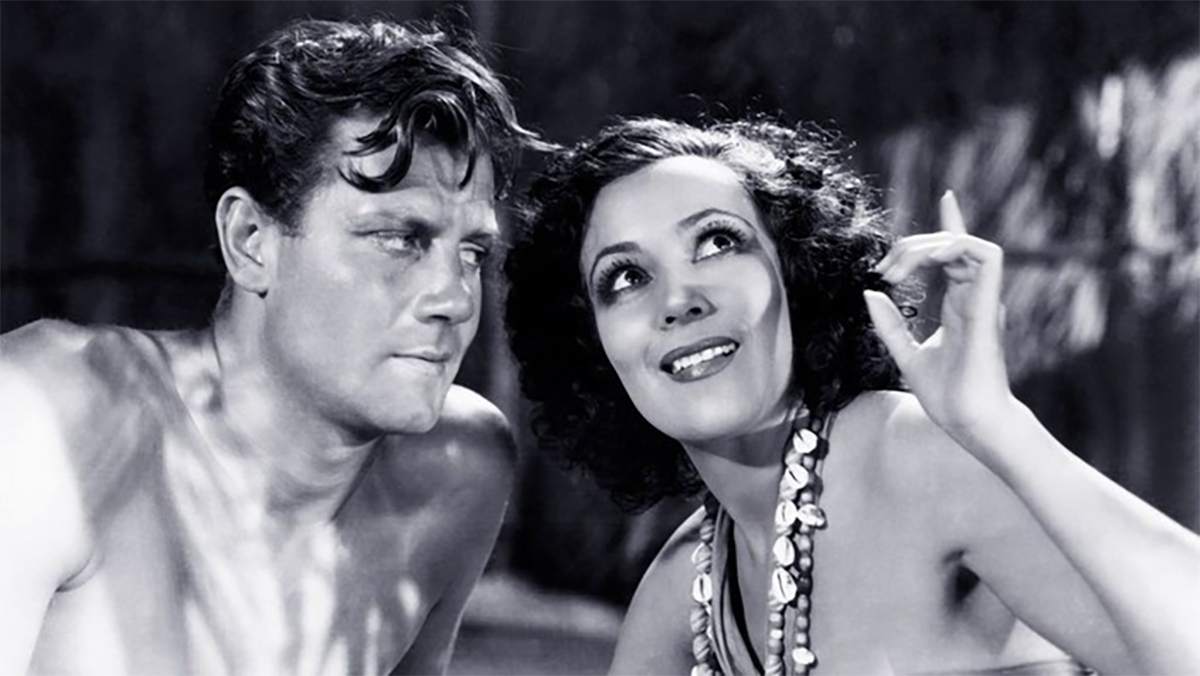
Bird of Paradise (1932). 80 minutes. Directed by King Vidor. Starring Dolores Del Río (as Luana), Joel McCrea (as Johnny Baker), John Halliday (as Mac), Richard “Skeets” Gallagher (as Chester), Bert Roach (as Hector), Lon Chaney Jr. (as Thornton), Wade Boteler (as Skipper Johnson), Napoleon Pukui (as the King), Agostino Borgato (as medicine man), and Sofia Ortega (as native woman).
Bird of Paradise is a pre-Code tropical romance that buzzes with as much sex on the beach as a cocktail bar on ladies’ night. The movie follows the story of Johnny, an American yachtsman who disembarks for a month on an island in the Pacific so that he can pant and drool over Luana, a young native woman who can barely speak English. Bird of Paradise holds together by virtue of its layers of fantasy, both sexual fantasy and the fantasy of “going native,” the latter of which Johnny attempts to realize on the island with only minor success. It takes a big, catastrophic volcanic eruption to bring about an end to the lovers’ time together, and we might think there is hardly a lustier, more melodramatic way to end a tropical romance—and we would be right. Bird of Paradise is the kind of movie that can let a volcano bring down the curtain and that can leave a lot of the talking for another day. Although the lava flows more easily than Johnny and Luana’s conversation, in this movie all it takes is some sunbaked sand and a beautiful woman to carve out a little bit of paradise for a young man amidst the human sacrifice, howling natives, and tectonic disruption of a nameless place in the ocean.
In Bird of Paradise, somewhere in the Pacific, a yacht and its crew land on a populated island for a day of fun and feasting. That night, American sailor Johnny is tantalized by a young native woman, Luana, and elects to remain there for one month while his fellow yachtsmen continue their tour of the nearby waters. During Johnny’s stay, he embarks on a romantic affair with Luana, but their relationship is thwarted when her father attempts to marry her to a native prince. Johnny runs off with her to another, uninhabited island nearby, where the two build a shelter and seemingly live in harmony with nature for a short period of time.
However, when the original island’s volcano erupts, Luana’s people come to fetch her back and take Johnny with them; they bind the two with the intention of throwing both in the volcano as a sacrifice to appease its anger. Johnny’s crewmen interrupt just in time, rescuing Johnny and Luana and bringing them back to the yacht. They intend to leave, but Luana’s father visits the yacht at night and persuades her to come back to the island and sacrifice herself to the volcano. She takes leave of Johnny and in the final shot, makes her way to the volcano and her death.
Bird of Paradise is above all a kind of swept-away sex romp that rests comfortably in the realm of pubescent fantasy. From the very start, the yachtsmen hope out loud that they will find compliant women and wanton romance when they disembark from their ship:
Chester: What do they call this place?
Johnny: Probably one of the Virgin Islands.
Chester: Heaven forbid.
The movie focuses on one woman in particular: the beautiful Luana, played by film sensation Dolores Del Río. Skimpy clothing (or no clothing at all) is de rigueur for Luana, and obliviously standing in a barely-there bralette amidst the palms and splashing around in the water sans swimsuit heighten her status as Bird of Paradise’s chief sexual object. The titular bird of paradise and creature of nature, she is also a “bird” in the derogatory, slang sense—a young, attractive woman who is there for us to project our dreams upon, whether she is diving naked like a mermaid in the nighttime ocean or running around with only a lei to cover her jiggling breasts (held in place and kept unseen by some magic tropical epoxy).
But it is Luana’s implicit desire to subject herself to one man’s whims that appears to be at least as much a part of Bird of Paradise’s fantasy. As soon as Johnny teaches her to kiss, her goal in life quickly becomes to recline in a luscious bower somewhere or other and neck all day with her handsome American sailor. She prearranges for a make-out session with him by carpeting a hidden patch of grass with flowers for his enjoyment and later serves him food and drink amidst the banana trees. (In one particularly cringey scene near the end of the film, she even regurgitates fruit juice into his mouth when he is dehydrated.)
Johnny must be some teacher, because not only does he educate her in the ways of love, but he helps Luana to learn enough English in a month to be reasonably understood. He is both the benefactor and the beneficiary of her linguistic accomplishments. For example, when the two are nearly sacrificed to the volcano, she proclaims her love for him:
I happy, Johnny. I happy you steal me away and we live together. I happy you teach me kiss. I happy you hold me. I happy for everything! It was best thing that ever come to me.
Once Johnny helps to unleash her experience of her erotic personal identity through his foxy coursework, Luana cannot help herself: she pursues him in spite of her culture’s expectations for her marriage to an island prince, temporarily abandoning her people in favor of a love-shack hideaway where she can endeavor to please her American man.
The subservient, colonialist overtones of their relationship are just one dimension of the pervy fun they have together. When Luana speculates that eventually, as part of her destiny as an island maiden, she will forsake Johnny in order to be sacrificed to the volcano, he commands her in a dom-style move not to leave him:
Luana: Someday, Pelle angry. Tom-toms call. I go.
Johnny: You mean to the volcano? I won’t let you go. You belong to me now.
But the characters’ power dynamic is best understood through their displays of physical fetishism. When Johnny first chases the naked Luana from the sea onto the beach, he holds her down in order to smooch with her while she fights back. (“Kiss me!” he exclaims. “Suppose I make you kiss me? I’ll teach you to run away from me.”) This is a pre-Code movie, so of course the fighting and Luana’s “no” are just a preamble to sex that she truly wants. Indeed, the two seem to enjoy physically tussling with each other in a kind of roughhousing foreplay, and they fight over who gets to hold the other down—so while she typically services Johnny, at times the two play at servicing each other and are capable of switching roles.
It is all a part of the movie’s master-servant, dominant-submissive fantasy. Even their declarations of love for each other on the night when they are both to be sacrificed to the volcano occur when they are tied up as prisoners and swinging from the roof of a hut, so the imagery associated with sex games still haunts the two characters even when they are near death. Their relationship is thus characterized by a kind of island kink, and their subversive approach to sex helps to make Bird of Paradise a naughty pleasure.
Through Johnny we also encounter the fantasy of “going native” or escaping into life outside of Western civilization. “Going native” is literally how Johnny’s fellow yachtsmen describe his plan for his time on the island, and in a way it makes sense to assign that term to his one-month-long vacation there. When Johnny disentangles himself from his sea-faring colleagues so that he can star in what essentially becomes his own personal adventure movie, it certainly looks as if he is bent on acclimating himself to native life. He makes a hut out of palms with his bare hands, hunts for pigs and dives for turtles, daringly climbs up a bending tree trunk to retrieve coconuts, dines on exotic fruit, uses vines to swing across a river of molten lava like Tarzan, leaps over earthquake-created fissures, and fights with a shark underwater. Johnny in his way conquers the habitat through a full range of activities as a kind of bro survivalist.
And yet for all of his desire to go native and for the apparent pleasure he takes in moments such as the successful capture of a massive tortoise, Johnny is not that keen on life on the islands. As an American interloper, agitator, and pest, he fundamentally opposes Luana’s culture, constantly interrupting its customs and traditional processes, and in many ways not adapting to the local practices. For example, Johnny arrives in a motor boat and ferries it around when needed, forgoing the canoes of the native population. The natives destroy the motorboat in order to run off with Luana at one point and prevent him from following, but instead of fully adapting to native culture by simply climbing into one of the island boats and paddling away, Johnny uses a portable gramophone to bribe a native woman for a canoe and then rigs the canoe up with the still-functioning motor so that he can zip around in the ocean and reclaim his lover. When he attends a flying fish expedition, he attempts to swat fish into the other boatmen’s nets with a tennis racket rather than taking up one of their nets himself. And Johnny can talk only of American football and indoor plumbing to Luana when she is lying invitingly on the floor of their makeshift bungalow (she falls asleep as he does so, presumably bored). He wants to take her to the big city, not stay forever in this dissatisfying place:
Johnny: I’m gonna take you back to civilization. They don’t have any crazy, superstitious ideas about volcanos being mad at people and puttin’ a curse on ’em.
Luana: Civilization? Where that?
Johnny: Well, that’s not a place. That’s where things are happening. People are accomplishing something.
Fittingly, Johnny’s yachtsman buddies come to rescue him just in time when he and Luana are bound and being carried on their way to become human sacrifices to the great volcano. Only through gunfire do the seamen retrieve Johnny and rescue Luana, sending men and women running in all directions and revealing Johnny’s low-key time on the islands to be backed up by weapons and violence. His tropical days are necessarily limited because he agrees to be picked up in one month by the yacht, but really Johnny was only a few steps away from his own society at any point after all. Stories where Westerners “go native” usually involve expansive time spent in the native environment, a willful forgetting of their ties to their own civilization, and a reluctance to return to non-native life. Johnny never commits to any of those things, and his days on the beach only confirm him as a tourist at a sort of private, all-inclusive resort.
Johnny’s efforts to live like a native may strike us as weak, especially because there are many, many natives in this tropical society that he could learn something from and does not. In spite of the abundance of the locals, however, we come to know so little about them. Their location, while clearly residing somewhere in the Pacific, is never identified by name. (Johnny arrives there with a ukulele, but it is not obvious if he has picked it up while visiting Hawaii and is still on a Hawaiian island, has acquired it in Hawaii but is now on islands somewhere else, or if he simply brought the ukulele from the States.) Luana’s language cannot be pinned down to any specific locale: before she learns English, Dolores Del Río as Luana speaks a kind of Hollywood gibberish masquerading as a Pacific islander language, so we never hear her say much that seems authentic, and Luana’s fellow natives merely yell and shout.
We see the natives feasting en masse, clustered together in boats, charging the sea, or performing assembled rituals around circles of fire. Nevertheless Bird of Paradise offers few glimpses of individual dwellings and no depictions of what the residents do from day to day. Apart from Johnny’s one encounter with a singular woman who is not Luana, there are no up-close vignettes with native individuals apart from the two women. And there are no real inner lives for natives that don’t involve Johnny, who is oblivious to any forces on the island greater than himself.
Heaven forbid a native person in Bird of Paradise should have their own adventures without someone like Johnny fighting with a shark, taking aid in a benevolent swimmer’s arms, and then essentially crashing on the island’s couch for a month like a slacker-adventurer beach bum with an untamed libido. One thing that we know the natives would not mind, to put it mildly, is if Johnny were fed to the volcano; indeed, they elect to sacrifice him along with the beautiful Luana (presumably as a bonus), even though he is no maiden. But it is not clear whether their volcano would be happy with this gesture or whether it would simply spit Johnny up and out.
The volcano’s peak puffs out black smoke and makes thunderous noise for almost half of the film. It is a metaphor for the protagonists’ fiery passion and a powerful symbol of the force of natural drives in their romantic lives—but it also essentially serves as the main subject of the vague glimpses that we get of the natives’ religion. So dominant is the volcano in the natives’ lives that the entire community appears to take the sacrificing of young ladies to it on a regular basis as a given, in order to appease its angry earthquakes and fiery eruptions.
But when Luana returns to the island in Bird of Paradise’s final moments to quell the volcano and make peace with her community, she is not merely grabbed up and fed to the volcano by fanatical thugs. Although when both she and Johnny are tied up and on their way to be sacrificed, Luana is genuinely upset, at the end of the film, she walks right up to the volcano, attired in feathery ceremonial dress, looking radiantly beautiful with a serene and determined face. Johnny may attempt to instill American values in her, but she ultimately rejects them in favor of the chants of her fellow island dwellers, her belief in the volcano as a god, and her conviction that only her sacrifice can save her people. It might be possible for Johnny to ensconce Luana temporarily on the yacht and endeavor to secret her away to the States, but she has a bit more of the volcano inside of her than he reckons—and more, perhaps, than we might initially have believed. Luana emerges in the last minutes of Bird of Paradise not as a gracious caregiver for a red-blooded hunk but as a hero, and suddenly the story is all hers.
Fortunately in paradise, a person does not have to be white to be fashioned as a savior. And equally as nice, Luana’s journey towards destiny—which is accompanied by the longboats of ceremony and piety—traces a path that is an ocean away from playboy adventurers on sporting yachts. Bird of Paradise may subject Luana to the studly Johnny for most of its running time, but when she breaks free from him at the movie’s conclusion, it becomes evident that she is the one who counts, both to her people and as the focus of the audience’s attention. Bird of Paradise may largely be about the sexual awakening and exploitation of a native fledgling, but it becomes clear at the end that it is what Johnny has to offer that is truly for the birds.