
Porky in Wackyland (1938). 7 minutes. Directed by Bob Clampett. Starring Mel Blanc (as Porky Pig and the Dodo). Animated by Norman McCabe, I. Ellis, Vive Risto, John Carey, and Robert Cannon. Layouts by Bob Clampett. Backgrounds by Elmer Plummer. Music by Carl W. Stalling. Produced by Leon Schlesinger.
Porky in Wackyland is one of only a handful of Warner Bros. cartoons that the U.S. Library of Congress has designated as “culturally, historically, or aesthetically significant” and selected for preservation in the National Film Registry. Its title may make it seem like a bit of a stale joke that is trying too hard; the word “wacky” always sounds like a marketing department’s corny way of exaggerating a movie’s quirky inscrutability in order to sell it as a wild ride that is in reality not so wild. Porky in Wackyland is legitimately zany, yet because it draws on Lewis Carroll’s Alice’s Adventures in Wonderland (1865) among other cultural touchpoints, the cartoon is also not so offbeat as to be incomprehensible. It actually makes a neatly executed visual argument for the liberated, unconventional, and iconoclastic spirit that Warner Bros. had embodied since its first cartoon in 1930 (Sinkin’ in the Bathtub). Warner Bros. would remain fully committed to this ethos even as the Walt Disney Studio increasingly journeyed down the opposite direction, towards cuteness and child-friendly stories. Porky in Wackyland can thus be seen as a kind of visual manifesto for Warner Bros., and it is therefore required viewing for anyone who cares about the history of animation.
The cartoon follows Warner Bros.’ iconic Porky Pig as he journeys to Wackyland in search of the last dodo. When he arrives, he encounters many strangely shaped figures who engage in eccentric behavior. Eventually, he finds himself face to face with the Dodo, who mischievously evades capture. Just as Porky has his hands around the neck of his antagonist, an overwhelming flock of dodos surrounds the pig, with each one proclaiming that they are the last of the dodos.
Porky in Wackyland makes deliberate use of Lewis Carroll’s Alice’s Adventures in Wonderland in its title and its details. Both Porky and Alice embark on quests: just as Alice searches for access to a beautiful garden, Porky searches for an animal that has nearly disappeared from the earth. Alice herself encounters a dodo in the first third of the novel, although even by the time of the nineteenth-century novel, dodos had been extinct for some time. Much like Alice, Porky journeys through a mysterious small door and falls down a slide from a great height. At the end of Porky’s fall, he emerges from a large spigot in a drop of dark liquid into what appears to be an oversized teacup. Of course, shrinking down in size is an important part of the Alice novel, and the mad tea party is one of the central and most iconic scenes in its narrative. Moreover, the concept of Wackyland as a place dominated by madness is a direct borrowing not only from Alice’s tea party chapter but also from the whole of Alice’s Adventures in Wonderland. In the novel, there is a pervasive sense that, although Alice is rational, the characters she encounters are by and large not right in the head, and in fact, Alice is told by the Cheshire Cat that “we’re all mad here.”
Supported by its roots in the Carroll classic, Porky in Wackyland thus offers its own version of a mad world. Importantly, however, it embraces madness not only by way of the Wonderland-like qualities of Porky’s zany adventures. It also does so through the bucking of cartoon conventions insofar as they relate to the physical appearance of Porky’s antagonists. In a more normative cartoon, we might be primed to expect, at the very least, that animated humans and animals—even characters who behave in a deranged way—conform to a certain amount of realism. We even expect this of inanimate objects in animation (see Disney’s Flowers and Trees [1932]). Instead, Porky in Wackyland creates a universe where it is difficult to understand what the creatures we see truly are.
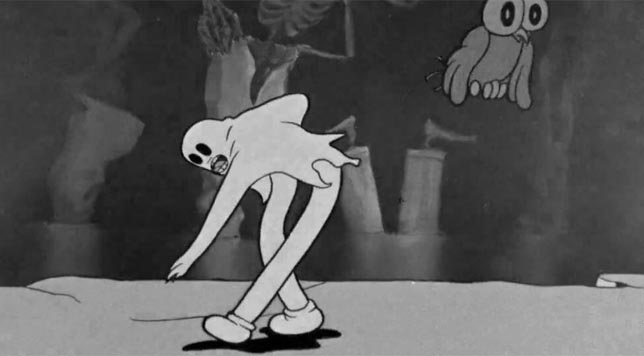
This is because in Wackyland, Porky encounters characters who are not drawn like him, including many stick-like figures, figures with exaggerated facial features, and so on. Not only is the appearance of the figures as thin, elongated lines with heads perched at their tops unnerving, but there is no attempt at realism in the figures’ behavior: we see a musician who plays multiple instruments, including his own nose; a three-headed organism resembling all of the Three Stooges whose heads fight amongst themselves; and the Dodo, who is drawn as a weird head on a line mounted to an oval, sometimes shown with arms and hands and sometimes not. The whole thing is a bit nightmarish, and we might actually take some relief in the image of Porky, who appears in many of the shots, simply because he resembles a pig whose animal form is fairly recognizable.
With its commitment to depicting non-human figures, Porky in Wackyland accordingly makes no attempt to show compassionate figures who care about either Porky or the Dodo. Then again, neither Porky nor the Dodo, as the two leads, cares for anyone else. The pig is set on his hunt, and the Dodo is set on thwarting the hunt—not obviously out of self-preservation or even out of love for anyone else in Wackyland, but rather out of a spirit of mayhem. The Dodo tricks and hurts our protagonist, even making him cry at one point, much as Porky tricks and tries (unsuccessfully) to hurt the Dodo. Porky sees the Dodo as a prize, and the Dodo sees Porky as an opportunity to injure another creature. And, of course, none of the stick figures that we see in Wackyland care an ounce for anyone else. Many of them are shown in isolated shots and do not even relate to each other spatially. The characters inhabit a harsh, unemotional world from which we might be grateful to depart at the cartoon’s conclusion.
At the same time, it is important to acknowledge that although Porky in Wackyland rejects realism, it also embraces some semblances of life outside of its storyline and outside of its specific animated world. We can see the cartoon reaching out to engage with popular culture through its references to common cultural touchstones. For example, over the course of Porky in Wackyland’s seven minutes, we see characters that clearly allude to figures from beyond the Warner Bros. universe—such as the Three Stooges in the form of the aforementioned three-headed monster; Al Jolson in the form of a duck-like creature singing “Mammy”; and a head that emerges from a cauldron and speaks in a baby-vamp voice, essentially doing a Betty Boop impression. These references are accessible to the audience and build continuity between Porky and Wackyland and other forms of entertainment, asserting the cartoon’s role in the wider film medium.
Porky in Wackyland is also fairly conversant with Warner Bros. animation. Most notably, the cartoon references Bugs Bunny, who made his debut in Porky’s Hare Hunt (1938) earlier in the year that Porky in Wackyland was released. Although Bugs Bunny would reach his full definition in Tex Avery’s A Wild Hare (1940), even in 1938 he was taking form as a sarcastic, New York-accented, clever adversary—specifically, as an adversary to Porky. The Dodo channels Bugs Bunny’s spirit in all of these regards. Even the large, bulked-up monster that Porky encounters at the boundary to Wackyland anticipates the saucy, gender-bending behavior that would come to be a hallmark of the rabbit. (The monster first roars menacingly before revealing his plumped red lips, whispering “boo,” and mincing away.) In this way, Wackyland is deeply grounded in Warner Bros.’ own milieu even though the cartoon’s fantastic, unrealistic-looking characters and unfeeling take on life may seem sui generis.
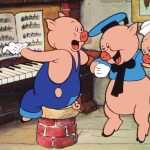
Through its unconventional depictions, timely cultural references, and quintessential Warner Bros. characterizations, Porky in Wackyland is engaged in a very real, wider discussion about animation at large—both at Warner Bros. and within the cartoon industry as a whole. For Porky in Wackyland should also be considered in comparison to what we increasingly see emerging from the Disney Studio, its chief competitor in the late 1930s. Disney had just released Snow White and the Seven Dwarfs (1937) the year before, which contains some moments of beautiful realism in the depiction of its evil queen, but which overall had signaled Disney’s descent into a softer kind of reality. Characters’ movements in Snow White are surprisingly life-like, but the film is plagued with round, bouncy dwarfs; cuteness; uplifting narrative conclusions; and wall-to-wall emotional warmth as conveyed through dwarf antics, super-sweet woodland creatures, and a radiating prince/princess love story. Although Snow White was made with a general audience in mind, Disney was already increasingly moving into wholesome, child-friendly territory by the time the feature-length film was made.
Yet Disney was breaking ground with animation technology. Starting in 1928, Disney had gained an edge commercially over its competitors through technical innovation, offering the first cartoon short to use synchronized sound in Steamboat Willie (1928), the first color cartoon in Flowers and Trees, the first cartoon to use an advanced multiplane camera in The Old Mill (1937), and the first feature-length cel-animated film in Snow White. Disney had exclusive rights to the color process for cartoon shorts, and so Porky in Wackyland was, even as late as 1938, still only a black-and-white cartoon. In comparison to Disney, Warner Bros., which started releasing animated shorts in 1930, might appear to have struggled as a younger sibling in animation that did not possess the same cachet.
Perhaps Porky in Wackyland is not notable for its technological breakthroughs in the way that the bulk of Disney cartoons from its era were. But the Warner Bros. cartoon, much like other Warner Bros. offerings of its time, presents its own innovations. Whereas Disney increasingly in the late 1930s opted for precious exchanges and happy endings, the Warner studio was committed to narratives with more of an edge, characters with a sometimes disturbing set of attitudes and behaviors, and an overall adult approach to storytelling. Think of how many unhappy endings there are in Warner Bros. cartoons, how many times a character acts out of blatant anger or a desire to harm someone else, and how much violence we see in the cartoons. Early Warner Bros. animation channels the human id, and perhaps that is one of the reasons that the cartoons are so pleasurable. Although they are now ubiquitous, they are not for the faint of heart.
Porky in Wackyland’s view of animation thus differs from Disney’s. This is nowhere as persistently evident as in the cartoon’s backgrounds—especially its flat, nearly blank horizon, which is constantly on display. Wackyland’s horizon in its ever-presence is as much the subject of the cartoon as Porky’s hunt for the Dodo is. And through its stark, unreal qualities, the skyline mimics the aesthetic that we see embodied by the cartoon’s various characters. True, Porky in Wackyland shows a sun going up, which we might imagine is a fairly conventional cartoon activity for a background to undertake, but the sun is supported by a pillar of crazed stick figures. We see the sky at night, but its stars are hanging by strings, so even the backdrop with its quirky sun and moon imagery does not conform to conventional realism.
The skyline is especially evident in the 1949 remake of Porky in Wackyland. That cartoon, Dough for the Do-Do, is a mostly literal color remake of the 1938 cartoon and consists of an almost frame-by-frame reproduction of the earlier short. But in addition to minor updates, such as the appearance of Porky’s clothing, the animators enhanced the backgrounds to include Salvador Dali-esque elements, including stark rock formations and weird references to Dali’s clock images. At times, the 1949 cartoon also removes some of the details of the foreground so that the entire floor in the front of the cartoon (where the action is) also looks especially blank—like a continuous, bare landscape that is stretching out and connected to the horizon. In this way, Dough for the Do-Do heightens Porky in Wackyland’s sense of the limitless, increasing our perception that the wacky activity we see has the potential to expand into infinity.
For just as the horizon is never-ending in Porky in Wackyland, so, too, is Warner Bros.’ commitment to offering this snarky, truly fantastic alternative to so much of other animation. Disney’s Snow White inhabits a world contained within and circumscribed by a well-defined forest environment. Nothing, however, reins in Porky in Wackyland’s terrain or otherwise curbs it. By extension, as the Wackyland horizon stretches out into a far-away world, the possibilities for creativity within the Warner Bros. universe in this moment become endless as well. The studio’s future in 1938 is an infinite, undefined canvas; and the unbounded landscape of the cartoon represents the revolutionary edge upon which Warner Bros. elected to sit.
Ironically, although Porky in Wackyland is not a part of the earliest waves of animation, it nevertheless channels the adventurous spirit of early animation as exhibited by artists such as Winsor McKay. Porky in Wackyland is thus striking not only because of its bold visuals and compelling themes but also because it resurrects the proclivities of its forefathers. While simultaneously looking backwards and moving forwards, the 1938 cartoon creates a special position for itself, a spot at which it can unabashedly be itself in the present even as it is ushering in a bold future for its studio. Warner Bros. would only grow and develop in its creativity, humor, and wicked sensibility over the decades that followed, but it would always point back to 1938 and this particular moment in its history, when the studio enshrined its worship of the unrealistic and most clearly articulated its insistence that the best animation is always adjacent to Wonderland.