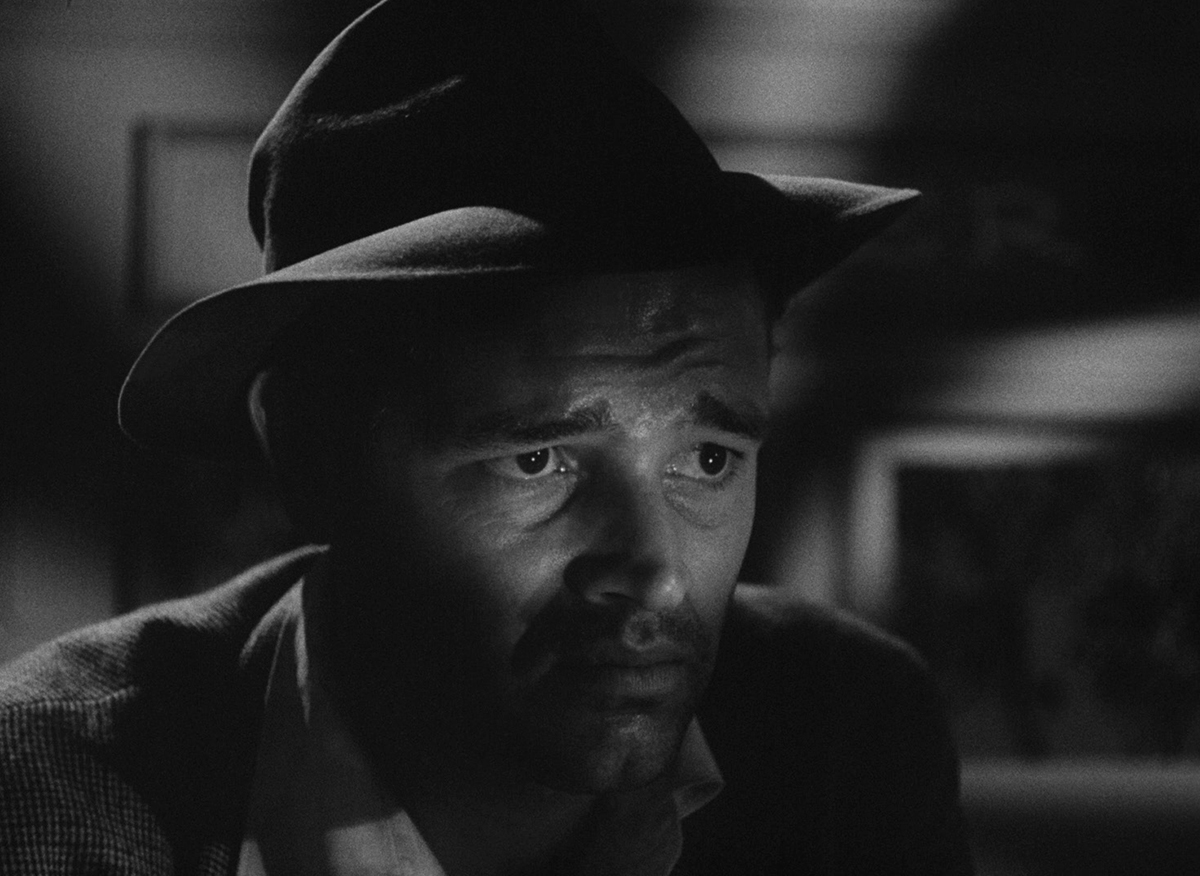
Detour (1945). 68 minutes. Directed by Edgar G. Ulmer. Starring Tom Neal (as Al Roberts), Ann Savage (as Vera), Claudia Drake (as Sue Harvey), Edmund MacDonald (as Charles Haskell, Jr.), Tim Ryan (as Nevada diner proprietor), and Esther Howard (as Holly). Cinematography by Benjamin H. Kline.
There is some dispute about how long it took to make Detour, a film noir from the so-called “poverty row” of the 1940s Hollywood studio system. Whether it took under a week (as many claim) or whether it took longer, the movie still has the appearance of an extremely economical endeavor, with very few indoor sets and only a handful of characters—even the car that carries the protagonist through the movie and is the source of so much of his troubles had to be borrowed from director Edgar G. Ulmer. Yet in spite of the movie’s limited resources and the fact that it was practically made to be forgotten, Detour manages to be a gritty noir masterpiece, and one of the gloomiest. Through poor choices, an intense fear of being misunderstood, a dread of punishment, and what may or may not be just plain awful fate, the protagonist Al Roberts seems doomed from the start. Complicating our understanding of the plot, however, is the fact that Roberts’s narration is unreliable, which muddies our ability to ascertain how much we can believe his take on events; and it is easy for the truth to slip through our grasp as we listen to his version of the story and feel the pounding hammer of his anxiety. Detour is like a field trip to the far edge of noir psychology, where the human guilt complex is handed out like a tawdry souvenir and where the warmth of daylight feels far away. It is all so dirty, miserable, and wonderful at the same time, and the fact that this movie was made on the cheap somehow makes it even more delicious. Detour may put the “poverty” in poverty row, but it is a sleazy gem at any price.
In New York, pianist Al Roberts works in a club with his singer-girlfriend Sue. Sue announces that she is heading to California to pursue a career in entertainment, and Roberts arranges to follow her out. He hitchhikes across the country until he makes it to the southwest. There he thumbs a ride with Charles Haskell, Jr., who has recently been riding with a physically aggressive woman who scratched up his arms. Haskell is kind to Roberts but dies in the middle of the night while Roberts is driving. Roberts panics and hides Haskell’s body, puts on Haskell’s suit, and drives off with his car. The next day, he picks up a hitchhiker named Vera, who, it turns out, is the woman who had previously been riding with Haskell (and is responsible for his scratches), knows Haskell’s car and clothes, and accuses Roberts of having murdered him. She forces Roberts to do her bidding or else she will turn him in to the police.
Once the two reach Los Angeles, she rents an apartment for them and insists that Roberts sell Haskell’s car for cash. At the dealer’s, she reads that Haskell, Sr. is on his death bed in Florida and demands that Roberts journey out there to impersonate Haskell, Jr. and claim an inheritance. He refuses. They fight back at the apartment, and when Vera locks herself in her bedroom with a phone, intending to call the authorities, he pulls on the phone cord to unplug it and accidentally strangles Vera to death in the process. He flees with the intention of living the life of a drifter indefinitely in order to evade the police and the punishment that he knows is waiting for him.
Detour was inexpensively thrown together, but it makes good use of its limited resources to create atmosphere and complexity. At the beginning of the film, in the shadows of the evening, Roberts pounds a piano in a dingy little New York City club where darkness and the concentration of the activity eliminate the need for more elaborate sets. The club is packed with extras at first to make it seem busy and full. Once Sue leaves town, however, the crowd thins out, and Roberts is left alone at his instrument. Somehow, the room seems smaller rather than larger with fewer people in it: we are suddenly aware of how few tables there are, how compact the stage is, and how insignificant Roberts’s career there is. We also see Detour using its economy to make a point when Roberts walks Sue home through a cheaply produced evening fog so thick that in some moments we can barely see them. They make their way through the dark streets and white mist, enveloped in the world of deep night as they travel only a few blocks. The fog disguises the fact that there is not a lot to walk past or much movement going on, but is also nicely enigmatic, suggesting that even early on there is something nebulous about the story we are about to see.
The dreary but pointed economy of Roberts’s life follows him even as he makes his way across the vast American highway. When Roberts journeys to the far west, he spends his days on the open road, but life ironically becomes more fenced in. For a great deal of this movie, we mainly see Roberts in a car or interacting with cars—symbols of American civic freedom and personal liberty. But the outdoors look like the same stretch of concrete for miles, the roadside diners are cramped and barely large enough for a single counter, and through these budget-minded locales, the freedom of travel comes to seem like a joke. If anything, Roberts’s choices grow narrower as he wanders through the desert like a nihilistic modern Moses, as he becomes trapped both physically and conceptually. Limited space becomes not merely a necessary feature of an inexpensively made movie but also a way of rendering the American dream puny and ill-conceived.
Even Roberts’s destination—the unparalleled Los Angeles, with its reputation for larger-than-life camera glitz and showbiz luxury—feels deflated and diminished through its minor sets and renders the glory of modern American cities a laughable fantasy. The entertainment capitol of the world, the land of dreams, is basically a drive-in, a used car lot, a seedy apartment, and some not well-defined back projections of traffic as Roberts and Vera drive along the streets. When Roberts phones Sue from the road, it turns out that she has made it to California and is slinging hash nearby somewhere, presumably in some tiny diner like the ones Roberts has encountered on his journey west. This is not the charmed life that either one of them was looking for. For Roberts, Hollywood is a meager apartment with a Murphy bed, mostly a single room where he and Vera survive powered by a bunch of bottles of cheap booze and a mountain of cigarettes, whose butts we see unceremoniously put out en masse in a dirty ashtray as the two smoke through packs of the things. Rather than functioning as a realm of exciting possibilities, the movie’s Los Angeles is efficiently rendered a kind of personal hellhole from which the only escape is the poverty and desperation of a life thumbing it on the same stretch of desert road just outside of what, given appearances, is just a small little town.
Detour’s cheap and sordid southern California is marvelously channeled by actress Ann Savage, who takes the movie’s budget schmutz and channels it into pure nastiness in the form of hitchhiker Vera. Savage takes the evil femme fatale Phyllis Dietrichson from Double Indemnity (1944), removes her charm, and replaces her manipulative, breathy declarations of love with angry threats delivered in a near-hiss. The result is a unique character that is hard for the audience, even an audience well-versed in noir, to anticipate. Vera’s face and its horrific snarl—her primary expression of her inner life—are more intense than almost any other female visage I can think of in American movies from this period. “Man, she looked like she had been thrown off the crummiest freight train in the world,” Roberts remarks in his voiceover upon meeting her. Like a rattlesnake, she wriggles her way along the desert road to the service station where she meets Roberts, then coils herself up in his convertible’s passenger seat as if she were a serpent baking in the noontime sun. When she starts to talk, she bares her fangs. No wonder Haskell has claw marks all over his arms: he “was tussling with the most dangerous animal in the world—a woman,” but not, as it turns out, with any ordinary woman. Vera is exceptionally wild and ferocious—“a little witch,” according to Haskell, and a sharp-ended desiccant that grows out of a waterless land.
It might be possible to pity Vera. She seems to maybe have tuberculosis, which would explain her sporadic coughing. And when she is drinking, she seems to hint at some affection for Roberts, at one point even subtly inviting him into her room in their shared apartment, an implicit proposition that he quickly shuts down. But she does not stay vulnerable or nice for very long, and she hardly is these things before Roberts meets her; the cuts on Haskell’s hands, which appear to be defensive wounds, are an inescapable physical marker of her vituperative streak.
Whatever empathy we might feel for Vera is short-lived. Her relationship with Roberts is like a domestic abuse case with the stereotypical gender roles reversed. She is the controlling, psychologically dominant one who battles with Roberts and succeeds in terrorizing him into submission. Like a psychotic mother from hell, she dictates where he lives, where he sleeps, what he drinks, where he drives, what they spend, whether they will or will not sell his car, and what his identity will be (demanding that he pretend to be married to her at the car lot, and shortly thereafter that he impersonate Haskell in the presence of Haskell’s ailing demented father back in Florida in order to secure the old man’s fortune). “Detour” is hardly the word to describe what happens to Roberts once he collides with Vera. Commandeered by her antagonistic will, he careens at full speed towards mental torture and sheer agony.
Why then, we might wonder, does Roberts stay with her? Why can’t he just pack up his things and drive off towards Sue? He maintains that Vera can ship him off to the authorities at any point, but does he really believe that? She is plastered for most of their time in L.A.—wouldn’t it be easy to escape? But Roberts maintains in his voiceover that fate is playing a cruel game with him in which he has limited input: “That’s life,” he says. “Whichever way you turn, fate sticks out a foot to trip you.” He muses about his encounter with Haskell:
I keep trying to forget what happened, and wonder what my life might have been if that car of Haskell’s hadn’t stopped. But one thing I don’t have to wonder about, I know. Someday a car will stop to pick me up that I never thumbed. Yes. Fate, or some mysterious force, can put the finger on you or me for no good reason at all.
Swept up in the belief that what happens to him is a kind of overpowering destiny that is beyond his control, Roberts assumes the worst: it’s straight to the gas chamber for him as far as he is concerned. (“I’d hate to see a fellow as young as you wind up sniffin’ that perfume Arizona hands out free to murderers,” Vera threatens passive-aggressively.) But based on what Roberts shares with us, would the law reasonably conclude that he is guilty? After all, Haskell is sick and popping some kind of pills that he keeps in his glove compartment. If there were an autopsy, surely Haskell’s death would not be ruled the result of foul play. Vera’s death poses more of a problem for Roberts as an examination of her body would not exonerate him. But even then, legally charging Roberts with murder would of necessity require a trial in which he would be allowed representation and would be judged by a jury of his peers that the prosecution would need to persuade in order to convict him. It is no matter: Roberts is on a runaway psychological train driven by a belief in forces greater than himself that, far from deriving the reassurance that comes from faith in a just and loving god, is instead fed by his innermost fears, a supernatural pessimism, and a heavy paranoia that is extreme even for film noir.
Yet Roberts also insists that fate, in spite of its oppressiveness, plays with us in a kind of delicate dance. Through a worldview that would do the scissor-wielding Fates of Greco-Roman mythology proud, he wants us to believe that his life is hanging by a thread and is as fragile as the material newspaper that tells him Haskell, Sr. is on his deathbed in Florida. After all, it will merely take a brief conversation on Vera’s end, a couple of words shared with the police, to damn him in this miserable world that hates a man full of regret who just can’t catch an even break. How precarious then is this life of his, that it only takes a few remarks over the phone to condemn a supposedly innocent man, or a moment of pulling on a phone cord to bring about someone’s death? In another world, phones would bring us together with others; but in Detour’s reality they are just a quotidian tool that can be transformed into a force of damnation—at least as much for the unfortunate Vera as for the equally unfortunate Roberts. In Roberts’s narrative, the line that separates us from injustice, like the phone cord, is thin and light, requiring only a few nasty tugs to tip us over from dreams of a sunny life with a significant other to a vision of a cheap little bedroom with one mean, dead broad lying in its center. It hardly seems fair.
Detour does not conceal Roberts’s perception of his relationship to a vengeful universe, but it behooves us to consider the more subtle dynamics of his relationship with us via his guilt-ridden narrative. Roberts proclaims his innocence to us, but importantly, he issues his self-defense in a kind of plaintive whimper, the voice of a tough guy who is nevertheless too weak to have made better choices. It is hard to imagine the morally compromised but admirable Sam Spade or Philip Marlowe, let alone the criminal protagonists of The Postman Always Rings Twice (1946) or Double Indemnity, moaning so much about how unjust life is.
Is Roberts manipulating us? After all, all first-person narrators (of which Roberts is one) are potentially unreliable. Roberts wants our trust, and he wants to be believed, but he has a lot to persuade us of. His account is as riddled with topsy-turvy explanations as the backwards, nonsensical footage of automobiles at the start of his journey: in what is probably a reversed negative, we see Roberts being picked up by cars driving on the wrong side of the road for the U.S., with drivers and steering wheels on the right-hand side of the cars. The reversed car images point to the upside-down nature of Roberts’s story, his existence on the wrong side of fact and reality. Could he—to some extent or in every respect, and despite everything his narration conveys to us—in reality actually be guilty of obstructing justice, engaging greedily in theft, and murdering innocent people?
He knows that what we are shown on screen is suspicious:
I know what you’re going to hand me even before you open your mouth. You’re going to tell me you don’t believe my story about how Haskell died and give me that “don’t make me laugh” expression on your smug faces. I saw at once he was dead and I was in for it. Who would believe that he fell out of the car? Why, if Haskell came to, which of course he couldn’t, even he would swear I conked him over the head for his dough. Yes, I was in for it.
We don’t even have to think that Roberts intentionally killed Haskell or Vera in order for us to register that he is putting up a lot of resistance in this speech (and in others) to what he acknowledges would be a reasonable conclusion on our part—namely, the conclusion that his story is much more straightforward than he would make it appear, and that he is up to no good on the road. Maybe Roberts is just the architect of a swell story. If that is true, his dead companions are the casualties of a man who is less of a victim and more of a victimizer. If he is not guilty, he does an awfully good job of opening up the possibility that the opposite is true. Roberts is about as easy to see through as the New York fog that envelops him along with Sue at the movie’s beginning: the challenge for us is to push through the mist and find something real and true. But the real and the true are far away from us in Detour, like the west coast is from the east; and we, resembling some peripatetic hitchhiker ejected from a car on a cross-country trek, are forced to spend most of the film stranded between myth and fact.
It is likely that we do not feel good after watching Detour. In addition to its heavy atmosphere of sleaze, there is something unnerving about the fact that the action of the entire movie is a distraction from Roberts’s road trip mission and from the life he has planned. Rather than experiencing a direct narrative with a set course, we are instead pulled off of and out of the movie’s main agenda—the journey towards Sue. “Until then I had done things my way, but from then on something stepped in and shunted me off to a different destination than the one I’d picked for myself,” Roberts reflects as the main action begins to unfold. The plot drives the activity forward, both literally and figuratively, but Detour careens sideways in a kind of violent slant that gets in the way of progress.
Is life one big detour? For the characters in this film, it certainly is. Their life on the road eclipses their life off the road, and all paths lead back to their time in cars, to the side of the highway—to grimy little diners with their too loud jukeboxes and their grub that requires more change than has collected at the bottom of Roberts’s meager pockets. Life on the road may be a distraction, but for the characters in Detour it is life. And maybe that is why the movie is so discomforting. In a sense, we expect to be taken care of in a movie. We expect for a story about a journey to follow its course. But for the characters and for us, Detour is an expedition into a reality that is far from linear and miles away from stable; and the movie’s deviation from a more straightforward road throws this film noir into the territory of weary, broken travel where no one, whether in the driver’s or passenger’s seat, is truly safe from the hard concrete roads, the punishing rain, or the dark nighttime of the soul.