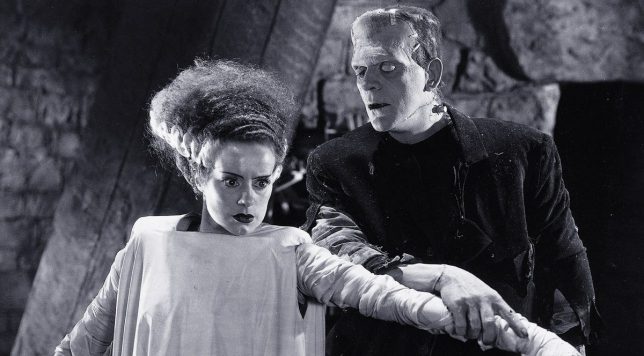
Bride of Frankenstein (1935). 75 minutes. Directed by James Whale. Starring Boris Karloff (as Frankenstein’s monster), Colin Clive (as Baron Henry Frankenstein), Valerie Hobson (as Elizabeth Frankenstein), Ernest Thesiger (as Doctor Pretorius), Elsa Lanchester (as the monster’s mate/bride of Frankenstein, and Mary Wollstonecraft Shelley), Gavin Gordon (as Lord Byron), Douglas Walton (as Percy Bysshe Shelley), Una O’Connor (as Minnie), E. E. Clive (as the Burgomaster), O. P. Heggie (as the hermit), and Dwight Frye (as Karl). Cinematography by John J. Mescall.
Bride of Frankenstein is one of those rare sequels that outdoes its predecessor. Frankenstein (1931), rooted in pre-Code and Depression-era culture, was itself a work of art and offered us insight into the 1818 novel of the same name by Mary Wollstonecraft Shelley. In the first film, Shelley’s protagonist, Henry Frankenstein, embarks on a grisly campaign to revivify human corpses with the aim of becoming god-like; he successfully regenerates life in the form of a humanoid monster. Bride of Frankenstein, however, takes as its central subject the creation of a mate for the monster and as a result touches more directly on topics such as sexual attraction, romance, and friendship. Bride of Frankenstein is an unusual horror movie: in addition to dealing with these topics, which may seem like uncommonly sensitive preoccupations for a Universal monster movie, the 1935 movie is a camp classic with a sometimes provocative comic edge that could prove a bit of a puzzle to some in the audience.
But Bride of Frankenstein is also a sad commentary on what happens to people who are different from the majority and reside on the boundaries of society. The movie is infused with a pervasive sense of loneliness that is hard to ignore. Because of its complex depiction of the human condition, its soulful meditation on the nature of outsiders, and its striking visuals, Bride of Frankenstein deserves to be considered one of the finest Universal monster movies and has rightly earned its place among the iconic films of the twentieth century.
Bride of Frankenstein draws inspiration from the 1818 novel Frankenstein by Mary Wollstonecraft Shelley and picks up where 1931 the film leaves off. Henry Frankenstein, having brought to life a monster assembled from corpse parts, thinks his creation has been destroyed; but really the monster has survived. In the midst of wreaking havoc on a nearby village, the monster befriends a hermit and begins to relearn human language. Meanwhile, a scientist named Dr. Pretorius enlists Henry’s help in furthering the science of human regeneration. Henry is unwilling until Pretorius kidnaps Henry’s wife, Elizabeth (using the monster, now separated from the hermit, as a henchman). The two scientists then proceed together on a quest to construct and revivify a mate for the monster—the bride of Frankenstein. Finally, the bride is created, but she rejects the monster. He destroys the lab while the bride, Pretorius, and himself are in it. Henry and Elizabeth escape and in the final moments watch the lab burn down from a distance.
The 1935 movie is more than a story about a mad scientist and his lab. Much like the 1931 Frankenstein, Bride of Frankenstein has beautiful, angular black-and-white shots of lab equipment, powerful lightning, and Henry at his work; it does not fail to deliver on the tense horror that it promises. But Bride of Frankenstein culminates in the production of a female mate for the franchise’s male monster, and thus the perceived necessity of a conjoined partnership resides at the film’s core, pushing its story well beyond a mere exploration of the mechanics of an unleashed, crazy science. Indeed, this film is largely about relationships and their influence on the monster, particularly with regard to his education and growth as a human being.
The movie’s depiction of same-sex relationships specifically has generated a great deal of viewer enthusiasm since Bride of Frankenstein was released in 1935, in part because it is a post-Code movie from the Golden Age period that nevertheless offers ample opportunities for a pre-Code-influenced style of reading. Indeed, even though Bride of Frankenstein came about in an era that had to code homosexuality implicitly on screen in order to avoid problems with the censors, its implied narrative is nevertheless not so coded as to be opaque. Essentially, Bride of Frankenstein is two movies: first, a movie that welcomes a plain and direct reading of its characters and events—that in other words treats Bride of Frankenstein as a surface-level story about two scientists who genuinely hate each other—and second, a movie that conveys an uncommented-upon subtext, a coexisting narrative about two men in a tense, almost erotic relationship with each other.
Henry’s adversarial relationship with Pretorius is ostensibly the opposite of erotic. After all, the two men are enemies, and Henry neither wants to deal with Pretorius nor does he want to participate in Pretorius’s scientific experiments. But the fact that Henry is repeatedly called back to Pretorius suggests that there is something about Pretorius and the man’s work that attracts Henry on a subconscious level. The latter scientist cannot escape from his colleague’s sway, however much he might fight against it. Henry’s professional struggles belie the complex identity of a man torn in two directions: towards his public-facing relationship with Elizabeth and his private relationship with Pretorius. His dual life could be part of his problem.
It makes sense then that the kind of experiment Henry and Pretorius undertake is a creative activity that is open to two men in a relationship with each other, not requiring a female participant apart from the corpse on the table. Perhaps the act of creation in Henry’s lab is itself related to reproductive realities for same-sex relationships. It is not coincidental that Pretorius actively prevents Henry from being with Elizabeth. In addition to kidnapping her and holding her hostage until Henry commits to producing the bride creature with him, Pretorius interrupts the couple when they are on something like a wedding night and journeying to a honeymoon. (Pretorius does this in order to call Henry off to urgent work in the lab.) In essence, he thwarts the newlyweds’ night of sex in what might implicitly be a gesture of hostility towards Elizabeth and an attempt to smuggle Henry out of his wedding bed and into the male space of the lab. Throughout the film, Pretorius’s behavior is manipulative, menacing, and cruel, but he is also perceptive: Henry might very well be happier if Elizabeth were out of the picture, for it is only without her that he can connect both with his creative ambitions and with the man who drives them forward.
The monster’s liaison with the hermit is tinged with the same explicit-versus-implicit dynamic as Henry and Pretorius’s interactions. The relationship between the two outcasts is ostensibly homosocial; homosocial behavior involves intense feelings of attachment between people of the same sex that are nevertheless not of a sexual nature. Additionally, the life that the monster shares with the hermit in the cabin, while tinged with notes of campiness, nevertheless can be seen as residing somewhere within the realm of monastic love. Monastic love can sometimes sound as if it is romantic (Christian love in general can seem this way), but traditionally monastics’ feelings for each other are always coded as brotherly or sisterly rather than sexual.
Yet in spite of the explanation that the monster and hermit’s feelings for each other can be attributed to either a friendly bond or the religious context of the hermitage, the pair inhabits even more fertile territory for subtext than Henry and Pretorius do. While Henry contends with a tortured sex life in the lab that lacks any surface-level markers of affection, the monster finds himself in a relationship with the blind hermit that is comparatively easygoing and characterized by deep attraction—even on an explicit level. Unlike Henry and Pretorius, the monster and the hermit genuinely like each other. The two seem to live together (either for a while or for one night—Bride of Frankenstein does not make that detail clear), and the hermit’s commitment to supporting the monster and the joy they both take in their relationship are obvious. Their trusting intimacy is significant: during the night they meet, there is a shot of the hermit placing the monster in the hermitage bed and kneeling over his body to say a prayer as the monster lies prone and vulnerable in front of him.
Their domestic partnership quickly grows to be more than a passing encounter and becomes a committed relationship, more so than any other pairing in the film. In Henry and Pretorius, we may see latent, combative desire running wild, but in the monster and the hermit, we see something that resembles a wholesome marriage, with all of the mutual affection we might ideally expect from such a pairing. Bride of Frankenstein only interrupts the couple through something external to them—a disastrous fire and two wandering hunters—but importantly if the fire did not occur and the hunters did not happen by, the monster and hermit would possibly continue their partnership forever. Their time together at the hermitage offers a bright spot in the film, both a glimmer of hope for the outcast monster and a nourishing example of the support and love that two people can have for each other.
While the scenes at the hermitage are fairly ardent, and the scenes in the lab are fraught with tension, beyond these scenarios we find a fair amount of humor in Bride of Frankenstein, largely residing in the film’s pronounced and widespread campiness. If we understand “camp” to mean comic exaggeration (at the very least), then we will notice tinges of this all throughout the film. For example, there is a ridiculous preamble featuring Mary Wollstonecraft Shelley, Percy Bysshe Shelley, and Lord Byron that depicts Byron rolling his r’s and claiming to be Europe’s greatest sinner; also in the opening, Mary Shelley accidentally pricks her finger with an embroidery needle, and Byron and Percy Shelley rush over to help her recover from this major event.
But there are also plenty of campy moments to be found in the story following the preamble: Una O’Connor’s wailing and flailing; Elizabeth’s hysterics while perched over Henry’s bed; the overaccentuated purity of a shepherdess; the hermit’s blindness and strident enthusiasm for a monster that he cannot see (indeed, some of the moments in the hermit scenes feel more like comedy than drama); the preponderance of booze and drinking; Pretorius’s workspace in the crypt, lit by candles perched on a tomb and full of his cackling; the historical figures that he has revivified, has shrunk, and stores in small glass bottles, with a sexed-up Henry VIII breaking out of his container, presumably to assault a queen in another bottle; and the monster’s dramatic movements and non-verbal sounds (that is, before he learns to talk). There is a decided bent towards hyperbolic humor, and while the performances are not ungainly, they do fit together to make for a flamboyant horror film.
Bride of Frankenstein’s world of camp includes numerous visual references to Christianity. We see a life-sized crucifix in a graveyard, a prominently displayed and bizarrely glowing crucifix in the hermitage, and an exaggerated cross around the neck of the shepherdess. There is also the sight of Una O’Connor comically crossing herself with a fervor, which appears to be undertaken out of wild superstition rather than piety. We find the monster captured by the villagers at one point and tied to a pillory, then raised up, appearing much like Christ on the cross (if Christ were a monster). All of these displays seem larger than life with the result that they come to reside on the verge of the obscene—but the movie hardly seems to regret any of this. Bride of Frankenstein happily and irreverently consumes Christian symbolism with the same playful, wink-wink approach it takes to Mary Shelley’s needle prick.
There are therefore many contenders for most over-the-top character or moment in this movie, but the monster’s mate takes the cake with her iconic and humorous physical appearance. Elsa Lanchester as the bride is done up with the exaggerated hair of a drag queen. It is both expertly waved and unnaturally high, supported by a wire frame and notably dyed with pronounced white lightning streaks on either side. (It is hard to believe that the bride woke up like this.) But her hair is not the only theatrical element of her appearance: while her arms are bandaged to her wrists, she is also wearing a voluminous, sparkling white gown that seems like a costume for a cabaret performance. All of the movie’s depictions of femininity, including this one, are decidedly over the top.
The highly coiffed, overdressed bride introduces an exaggerated dimension to the film’s conversation about partnerships. But in another sense, the introduction of the bride to the monster has a more delicate quality. When the monster sees his bride in the lab, he refers to her with the humble “friend” rather than another term, such as “bride” or “lover” or even “woman.” Indeed, it is not clear that he has learned any of those words, but he has learned “friend” from the hermit. It would appear that the monster is likening his bride to the hermit and is casting her in the terms of the only real relationship he has had. Invoking his memory of the hermit could imply that he is attempting to apply his feelings for the hermit to the bride and therefore to open up the possibility of a similar relationship with her.
Regardless of how the monster uses the term “friend” here, his language does not result in an actual sexual relationship or, for that matter, any kind of relationship with the bride. He may have developed a limited vocabulary, but the bride can merely histrionically hiss, and when she does, she hisses in the direction of the monster. The two scientists can put her in the whitest, largest dress they can find, but it is not clear how the two creatures could be married or otherwise brought together. (How would they even give their consent?)
And this is unfortunate because we might imagine a different relationship for the two of them, one where they immediately and mutually grasp their similarities and experience a moment of intimate recognition together; but there is no happy ending for either the monster or the bride. There will be no wedding night for them—Henry’s act of creation was a display of his scientific prowess, not an exercise in compassion. Elizabeth and Henry’s marriage and wedding night seem like a privilege that will forever be denied to Henry’s creatures. The lab-grown bride and monster are both doomed from the beginning, even before the lab is destroyed with them in it.
The bride’s rejection of the monster in such extreme terms highlights his central, solitary experience of life. The monster often is depicted by himself: for example, consider the scene where, after being chased, he wanders into a crypt and hides in the shadows among the dead. The dead are perhaps the monster’s best company, next to the hermit—for they, like the hermit, cannot see the monster or judge him. They cannot yell or make a fuss, and like the monster, they are most at home in their graves. His loneliness in the crypt, combined with his other experiences, provides him with a deep experience of human sadness, even loss.
Instead of finding acceptance from the world outside of the hermitage, he is cast adrift in a straitlaced world that treats those who do not fall in line as freaks. The monster may attempt to interact peaceably with human society, but he is rebuffed, endangered, and hunted as a result—in a horror plot that overtly pertains both to a monster let loose on society and to a society let loose on someone who differs from the norm. We should consider what happens when he shows tenderness towards another person. Think of the shepherdess whom he encounters in the woods and saves from drowning—her first reaction upon seeing him is to scream, even though he attempts to approach her gently. He even tries to help her when she passes out in front of him, but her fellow shepherds sound the alarm and race after him, assuming that he has harmed her. After the encounter with the shepherdess, the monster’s lack of friends is surely what drives him to befriend Pretorius, but Pretorius only uses him as a dumb agent of destruction. So in his relationship with Pretorius, which is the longest he has on screen with anyone in the movie, he is exploited as a kind of brutal underling—not treated as an equal and not perceived of as someone worthy of love.
But it is not just Pretorius or the shepherdess’s companions who mistreat the monster. Whether lying still in the lab, wandering peaceably in the crypt, or running loose in the countryside, the monster experiences a series of missed opportunities for the expression of human warmth. He is wholly himself in this film, honest and open to experiences, and not a concealer of his own grotesquery. But outside of the hermitage, being yourself in the movie’s world means maltreatment and a dreadful solitude. Without an intimate partner to love him in the way that he needs to be loved, the monster’s experience of life is its own horror show.
As it charts the monster’s solitary journey, Bride of Frankenstein becomes the monster’s movie—the story of his search for compassion in a cruel world. To underscore the extent to which the monster is the primary identifiable character in Bride of Frankenstein, we ought to contemplate who other than the monster we might liken ourselves to. Are we supposed to admire Henry or Pretorius, with their exploitative experiments? Or Elizabeth, with her intense fear and lack of insight into Henry’s life? Or the many villagers, running around with torches, shouting in a commotion—set on killing, reluctant to think? The monster is the obvious character for us to apply our sympathies to.
The pattern of his life on the fringes of society holds up a mirror to us and the general loneliness of the human condition. Society is teeming with insensitive antagonists, Bride of Frankenstein seems to say—hell bent on destroying divergent creatures with pitchforks and flames. In the end, when the bride rejects the monster and he is left with no one, not only is our hope that he might find permanent companionship dashed, but to the extent that he is like us, our hope for ourselves dies a little, too.
Whereas the 1931 Frankenstein movie causes the audience to examine the ethics of creating life, Bride of Frankenstein encourages us to think about the ethics of being alive—as applied both to the monster and to us. Henry Frankenstein may regenerate life and feel like a god, but Bride of Frankenstein contemplates what happens on the day when the gods rest and life grows into itself. The story of Henry’s grand ambitions may be the source of excitement in Bride of Frankenstein, but the real story is the monster’s and by extension our own. For we, too, could very well have been manufactured by the kind of gods who are more concerned with raining electrical pulses down from the sky than with our wellbeing—leaving us, loveless and searching, to stumble along on the ground below.